Pondicherry sits at a useful point on the map for temple travel. The Cauvery delta, where the Chola kings built their greatest shrines, starts roughly two to three hours to the south. Chidambaram is a little over an hour away, Tiruvannamalai about two. Madurai and Rameswaram are further, but still reachable without a flight.
That puts four well-known temple circuits within reach: the Navagraha (nine planets) temples, the Pancha Bhoota Sthalam (five elements) temples, the Great Living Chola Temples, and the southern run through Madurai and Rameswaram. They are often lumped together as ‘temple tours’, but they suit very different travellers. This guide compares them side by side so you can pick one, or combine two, without over-packing your days.
On this page
- The four circuits at a glance
- Navagraha temple circuit: for planetary remedies
- Pancha Bhoota Sthalam: the five elements of Shiva
- Great Living Chola Temples: for architecture and history
- Madurai–Rameswaram: the big southern pilgrimage
- How to choose: a quick decision guide
- Practical tips for any temple circuit
- Frequently asked questions
The four circuits at a glance
Distances below are approximate road figures from Pondicherry and vary with the route taken. Days are our practical suggestion for an unhurried trip with a car and driver, not a fixed rule.
- Navagraha temples: nine small-to-medium temples around Kumbakonam and Mayiladuthurai, about 130–150 km away. Suits devotees doing planetary remedies (parihara). Allow 2 days.
- Pancha Bhoota Sthalam: five Shiva temples, each linked to one element, spread from Chidambaram to Srikalahasti in Andhra Pradesh. Suits Shaivite pilgrims and those who want the ‘complete set’. Allow 4–5 days.
- Great Living Chola Temples: three UNESCO-listed temples at Thanjavur, Gangaikonda Cholapuram and Darasuram. Suits history and architecture lovers, and families. Allow 2 days.
- Madurai–Rameswaram: the Meenakshi temple and the Ramanathaswamy temple, optionally extended to Kanyakumari. Suits first-time visitors who want South India’s most famous shrines. Allow 4–6 days.
Navagraha temple circuit: for planetary remedies
The Navagraha temples are nine separate shrines, each associated with one of the nine celestial bodies of Hindu astrology. They are Suryanar Kovil (Sun), Thingalur (Moon), Vaitheeswaran Koil (Mars), Thiruvenkadu (Mercury), Alangudi (Jupiter), Kanjanur (Venus), Thirunallar (Saturn), Thirunageswaram (Rahu) and Keezhaperumpallam (Ketu). Eight of them are in the Cauvery delta districts of Tamil Nadu. Thirunallar is the exception: it lies in Karaikal, which is part of the Union Territory of Puducherry.
Many visitors come because an astrologer has recommended a visit to a particular graha temple, or to all nine. The temples themselves are mostly compact village shrines rather than huge complexes, so the day is spent more on the road than inside any one temple.
Days needed: the nine temples can be squeezed into one very long day from a Kumbakonam base, but it means rushing between pujas and arriving at some temples just as they close for the afternoon. Two days, with a night in Kumbakonam, is far more comfortable.
Route from Pondicherry: drive south via Cuddalore and Chidambaram, or inland via Panruti, to Kumbakonam (about 3 hours). Our Navagraha temple tour follows this pattern.
Good to know: temple timings in the delta usually include a midday closure. Saturn transit days (Sani Peyarchi) bring very large crowds to Thirunallar, so check the calendar if you want a quiet visit – or plan around it if you want to be there for it.
Pancha Bhoota Sthalam: the five elements of Shiva
The Pancha Bhoota Sthalam are five Shiva temples, each representing one of the five elements. Four are in Tamil Nadu and one is in Andhra Pradesh:
- Earth: Ekambareswarar Temple, Kanchipuram
- Water: Jambukeswarar Temple, Thiruvanaikaval near Trichy
- Fire: Arunachaleswarar Temple, Tiruvannamalai
- Air: Srikalahasti Temple, Andhra Pradesh
- Space (akasha): Thillai Nataraja Temple, Chidambaram
Who it suits and how long it takes
This circuit suits devotees of Shiva and travellers who like completing a traditional set. It also covers some of Tamil Nadu’s largest and most atmospheric temples: Tiruvannamalai, with Arunachala hill behind it, and Chidambaram’s golden-roofed Nataraja shrine are highlights even for non-pilgrims.
The catch is geography. Chidambaram (south of Pondicherry) and Trichy (south-west) sit in one direction; Tiruvannamalai, Kanchipuram and Srikalahasti in another. Srikalahasti is roughly 260–275 km from Pondicherry by road. Plan on 4 to 5 days for all five without exhausting drives.
A common approach is to do the three northern temples (Tiruvannamalai, Kanchipuram, Srikalahasti) as one loop and Chidambaram plus Thiruvanaikaval as another. See our Pancha Bhoota Sthalam tour for a worked itinerary. If you only have one day, a Tiruvannamalai and Gingee day trip covers the fire temple on its own.
Great Living Chola Temples: for architecture and history
UNESCO lists three temples together as the Great Living Chola Temples: the Brihadisvara Temple at Thanjavur, the Brihadisvara Temple at Gangaikonda Cholapuram, and the Airavatesvara Temple at Darasuram near Kumbakonam. Thanjavur was inscribed in 1987 and the other two were added in 2004. They date from the 11th and 12th centuries and are still active places of worship – hence ‘living’.
This is the circuit for people who want to understand what they are looking at: the scale of Thanjavur’s vimana, the curved tower at Gangaikonda Cholapuram, the fine carving and chariot-shaped mandapa at Darasuram. It works well for families and mixed groups where not everyone is there for worship, because all three are open, spacious sites.
Days needed: two days is ideal. Gangaikonda Cholapuram lies on the way from Pondicherry, so you can see it on day one, stay in Kumbakonam or Thanjavur, then cover Darasuram and Thanjavur on day two before heading back.
Route from Pondicherry: Thanjavur is about 170–180 km by road. Our Great Chola Temples tour is built around this route, and it combines easily with the Navagraha temples since both circuits use Kumbakonam as a base.
Madurai–Rameswaram: the big southern pilgrimage
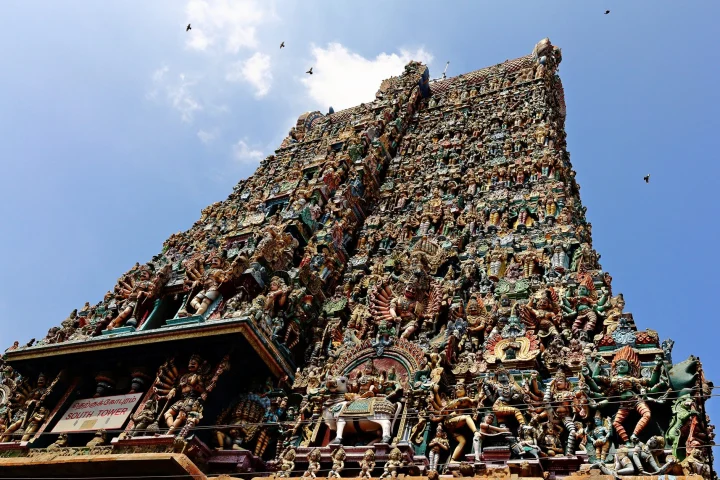
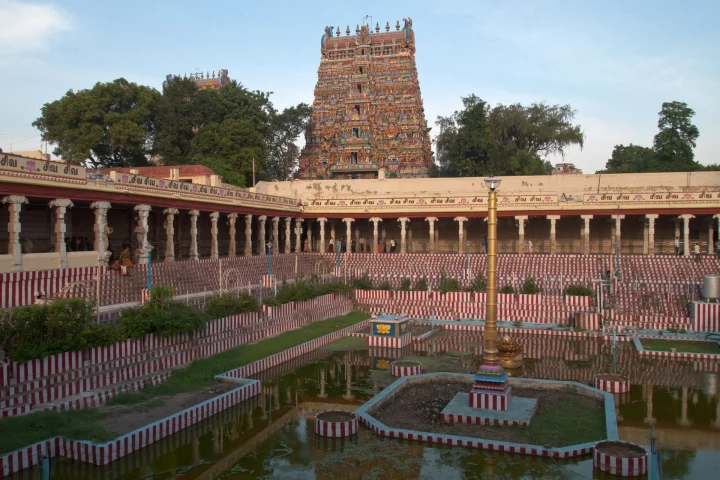
This is the circuit most first-time visitors to Tamil Nadu have heard of. Madurai‘s Meenakshi Amman temple is a city within a city, with towering painted gopurams and long pillared halls. Rameswaram, on Pamban Island, is one of Hinduism’s holiest pilgrimage towns, known for the Ramanathaswamy temple and its long corridors and sacred wells (theerthams).
Days needed: Madurai is roughly 330 km from Pondicherry, a full day’s drive, and Rameswaram is about another 175 km (around 3–4 hours). Allow at least 4 days for Pondicherry–Madurai–Rameswaram and back. Adding Kanyakumari at the southern tip takes it to 5–6 days.
Route from Pondicherry: the usual road route runs via Trichy, which lets you break the journey at the Srirangam and Thiruvanaikaval temples. Our Madurai–Rameswaram–Kanyakumari tour and Trichy–Thanjavur–Madurai tour are both built on this corridor.
Suits: first-timers, families who want the ‘big names’, and pilgrims completing a Kashi–Rameswaram yatra.
How to choose: a quick decision guide
- You have an astrologer’s recommendation → Navagraha temples.
- You love architecture, sculpture or Indian history → Great Living Chola Temples.
- You are a Shiva devotee with 4–5 days → Pancha Bhoota Sthalam.
- It’s your first temple trip in South India → Madurai–Rameswaram, via Trichy and Thanjavur if time allows.
- You only have 2 days → Chola temples or Navagraha (or a mix, since they share the Kumbakonam base).
- You have 8 days or more → combine several circuits, as in our Grand Tamil Nadu temple tour.
Practical tips for any temple circuit
Start early. Most large Tamil Nadu temples open around dawn and close for a few hours in the afternoon before reopening in the evening, so a 6 am start lets you fit in two temples before lunch. Exact hours vary by temple and on festival days – check locally before you go.
Dress conservatively and expect to leave footwear outside. From September 2026 the Tamil Nadu HR&CE department has also begun enforcing a ban on mobile phones inside major temples, with deposit counters at the entrance. Our separate guide to temple dress code and etiquette in Tamil Nadu covers this in detail.
Avoid the heat. April to June is very hot on the plains, and stone floors burn bare feet by late morning. October to March is more comfortable, although October to December is also the north-east monsoon season, so leave some slack in the plan for rain.
Don’t over-schedule. Three large temples a day is plenty. The delta’s village roads are narrow and slow, and you will want time for darshan queues, prasadam and simply sitting in a mandapa.
Official information: UNESCO World Heritage Centre
Frequently asked questions
Can the nine Navagraha temples be covered in one day?
It is possible from a Kumbakonam base with a very early start, but it is rushed because most temples close for a few hours around midday. Two days gives time for proper darshan at each temple.
Which Pancha Bhoota temple is not in Tamil Nadu?
Srikalahasti, the temple of the air element, is in Andhra Pradesh. The other four – Kanchipuram, Thiruvanaikaval, Tiruvannamalai and Chidambaram – are in Tamil Nadu.
What are the Great Living Chola Temples?
They are three UNESCO World Heritage temples built by the Chola dynasty: the Brihadisvara Temple in Thanjavur, the Brihadisvara Temple at Gangaikonda Cholapuram and the Airavatesvara Temple at Darasuram.
How many days do I need for Madurai and Rameswaram from Pondicherry?
Allow at least four days for the round trip, as Madurai alone is a full day’s drive. Add one or two days if you want to include Kanyakumari.
Is Thirunallar Saneeswaran temple in Tamil Nadu?
No. Thirunallar is in Karaikal district, which belongs to the Union Territory of Puducherry, although it is usually visited as part of the Navagraha circuit around Kumbakonam.