This day trip takes you inland from the coast to two very different sights in the same district belt: a hill fortress fought over by Marathas, Mughals, the French and the British, and a temple town that has drawn pilgrims to the sacred hill of Arunachala for centuries. The two are only about 40 km apart, and together they make one of the most satisfying day trips from Pondicherry.
The whole loop is about 215 km, with roughly five hours of driving. You travel in a private AC car and can spend as long as you like at either stop.
Who it suits
Pilgrims visiting Arunachaleswarar or Ramana Ashram, history lovers, photographers and active travellers who want a climb. If you do not want to climb, the lower fort at Gingee is still worth an hour, and the rest of the day involves only easy walking inside the temple and ashram in Tiruvannamalai.
Route at a glance
- Pondicherry → Gingee Fort: about 67 km, 1.5 hours
- Gingee → Tiruvannamalai: about 40 km, 1 hour
- Tiruvannamalai → Pondicherry: about 105 km, 2.5 hours
Why Gingee comes first
The climb to Rajagiri is exposed and the rock heats up quickly, so it is far more comfortable before 11 am. Entry to the hill also stops in the early afternoon at the time of writing. Arunachaleswarar Temple, on the other hand, stays busy but open until late in the evening, so it sits well at the end of the day. Returning from Tiruvannamalai directly to Pondicherry avoids driving the same road twice.
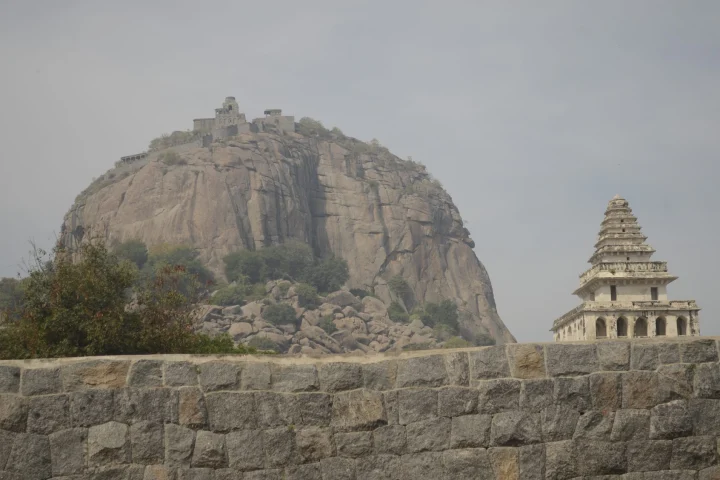
Gingee’s three hills – Rajagiri, Krishnagiri and Chandrayandurg – are linked by walls that enclose a large area. The fort is protected by the Archaeological Survey of India; carry a little cash for the entry ticket in case card payment is unavailable.
Best season
November to February is best for climbing Gingee. In summer, climb only if you can start by 9 am and carry plenty of water. Tiruvannamalai is at its busiest on full-moon (pournami) nights, when thousands walk the Girivalam path, and during the Karthigai Deepam festival (November–December), when a great flame is lit on the hilltop. These dates are memorable but crowded – tell us if you want to plan around them, or avoid them.
Ways to customise
- Stay overnight in Tiruvannamalai to walk the 14 km Girivalam path at dawn or on a full-moon night
- Skip Gingee and spend a full day at the temple and ashrams
- Extend to Kanchipuram as part of our Pancha Bhoota Sthalam tour – Arunachaleswarar is the fire temple of the five
- Hotels or ashram-area guesthouses in budget, standard or premium categories for overnight stays
- Pickup from Chennai or Bangalore on request; coming from Bangalore, Tiruvannamalai lies on the way, so the route can be run in reverse
A short history of Gingee Fort
Gingee was first fortified by local chieftains and greatly strengthened by the Nayaks under the Vijayanagara empire in the 16th century. Chhatrapati Shivaji took it in 1677, and it later withstood a long Mughal siege before falling in 1698. The French held it from 1750 until the British captured it in 1761. Most of what you see today – the walls linking the three hills, the Kalyana Mahal with its pyramid-like tower and the granaries – dates from the Nayak period. The fort is now protected by the Archaeological Survey of India.
What to wear and carry
For Gingee: sturdy shoes with good grip, a hat and at least a litre of water per person; there are monkeys on the hill, so keep food out of sight. For the temple and ashram: modest clothing covering shoulders and knees, and sandals that are easy to slip off. Mobile phones and cameras may be restricted inside parts of the temple, and silence is expected in the ashram meditation hall.
Frequently asked questions
How far is Tiruvannamalai from Pondicherry?
Tiruvannamalai is about 105 km from Pondicherry by road, roughly 2.5 hours’ drive. Going via Gingee makes the outward leg about 107 km.
How long does it take to climb Gingee Fort?
The Rajagiri climb usually takes 45 minutes to an hour each way, up several hundred uneven stone steps. Allow at least 2.5–3 hours for the climb and the lower fort together.
Is this day trip suitable for senior citizens?
Yes, if the Rajagiri climb is skipped. The lower fort, the temple and the ashram are all on level ground, though the temple compound involves a fair amount of walking barefoot.
Can this tour be customised?
Yes. You can drop Gingee, add an overnight stay for Girivalam, or combine it with Kanchipuram and other temples. Send your plan on WhatsApp and we will suggest timings.
Can you pick us up from Chennai or Bangalore?
Yes, pickup from Chennai or Bangalore can be arranged on request. From Bangalore, Tiruvannamalai is on the way, so the route can be reversed.