This full-day trip combines two of the best sights north of Pondicherry: the heronry at Vedanthangal, where thousands of water birds nest each winter, and the Pallava rock-cut monuments of Mahabalipuram, a UNESCO World Heritage Site. The early start is worth it: birds are most active in the first hours after sunrise, and the monuments are cooler and quieter before noon.
You travel in a private car with a driver who picks you up from your hotel before dawn and brings you back in the evening.
Who this trip suits
Nature lovers, photographers and families staying in Pondicherry who want a change from temples and beaches, and first-time visitors who have not yet seen Mahabalipuram. You don’t need to be an expert birder – the nesting colonies are large, noisy and easy to see from the bund, and even young children enjoy watching pelicans bring in fish for their chicks.
Vedanthangal is seasonal – read this first
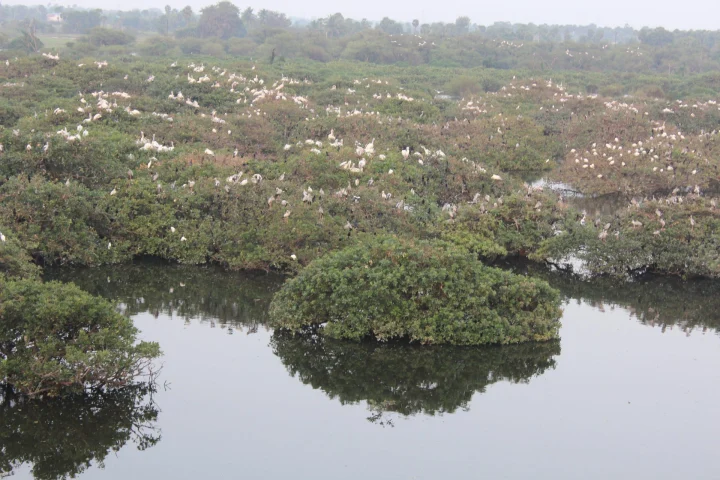
Vedanthangal is a village irrigation tank, and the birds come only when it has water. It usually fills with the northeast monsoon rains (October–December), and the nesting season normally runs from about November to March, with December to February usually the busiest months. If the monsoon fails, the tank can stay low and bird numbers drop sharply.
Between April and October there is often little water and few birds. During those months we suggest skipping Vedanthangal and adding Kanchipuram’s temples to the Mahabalipuram day instead – see our Mahabalipuram & Kanchipuram heritage tour. We are happy to check reports on water levels before you book.
About Vedanthangal Bird Sanctuary
Villagers here have protected the nesting birds for centuries, because the droppings enrich the tank water that irrigates their fields. Their rights were recognised by British officials in the late 18th and 19th centuries, and the area was formally declared a sanctuary in 1936. It is small – about 30 hectares – but it can hold tens of thousands of birds in a good year, and it was designated a Ramsar wetland of international importance in 2022.
The main nesting species are spot-billed pelicans, painted storks, Asian openbills, black-headed ibises, egrets, herons, cormorants and darters. Migratory ducks such as pintails and garganeys also visit. Nearby Karikili Bird Sanctuary is another nesting site if you want to see more.
The Shore Temple and Pancha Rathas
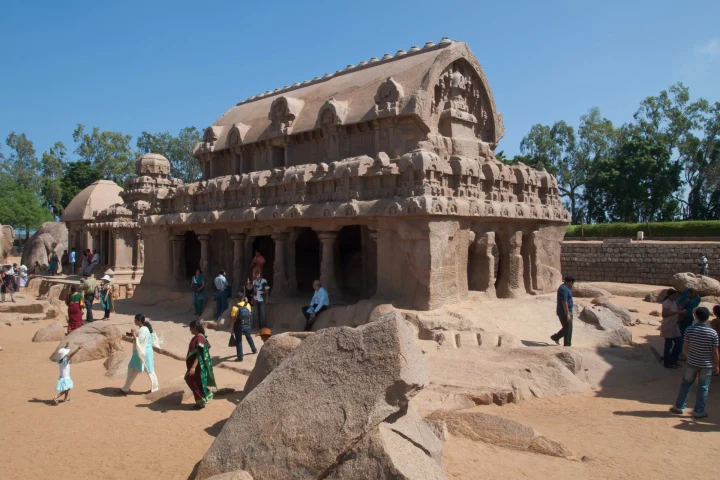
Mahabalipuram was a port of the Pallava kings, and its monuments, carved mainly in the 7th and 8th centuries, were listed by UNESCO in 1984 as the Group of Monuments at Mahabalipuram. The Pancha Rathas are named after the five Pandava brothers of the Mahabharata, though they were never used for worship. The Shore Temple, one of the earliest structural stone temples in South India, has survived centuries of salt wind and waves. For more on the town, see our Mahabalipuram guide.
Route and timing
We do Vedanthangal first because the birds are busiest at dawn and settle down by mid-morning, while Mahabalipuram can be enjoyed at any time of day. If you would prefer a slower pace, stay the night in Mahabalipuram and see the monuments at sunset and again the next morning before returning to Pondicherry.
- Pondicherry → Tindivanam → Madurantakam → Vedanthangal: about 100 km
- Vedanthangal → Chengalpattu → Thirukazhukundram → Mahabalipuram: about 55 km
- Mahabalipuram → East Coast Road → Pondicherry: about 95 km
- Total: about 250 km and 5.5–6.5 hours of driving
Tips for the day
- Bring binoculars; a camera with a zoom lens helps at Vedanthangal, where the nests are across the water
- Wear neutral colours and keep your voice low near the colonies
- Carry water, a hat and sunscreen – there is little shade at the Mahabalipuram monuments
- Sanctuary and monument timings can change; check before you go
- Children usually enjoy both halves of the day, but the early start is tough for toddlers
Official information: UNESCO World Heritage Centre
Frequently asked questions
When is the best time to visit Vedanthangal Bird Sanctuary?
From about November to March, when the tank has water after the northeast monsoon and birds are nesting. Early morning is the best time of day.
How far is Vedanthangal from Pondicherry?
Vedanthangal is roughly 100 km from Pondicherry by road via Tindivanam and the Chennai–Trichy highway, about two hours by car.
Is Vedanthangal worth visiting in summer?
Usually not. From April to October the tank is often low and few birds are present, so we suggest adding Kanchipuram to your Mahabalipuram trip instead.
Can I see the Shore Temple and Pancha Rathas with one ticket?
At the time of writing, yes – the ASI ticket for the Mahabalipuram group of monuments covers both on the same day. Fees and rules can change.
Is this day trip suitable for families?
Yes. The walks are short and on level ground. The only challenge is the early start, which is needed to see the birds at their most active.