Mahabalipuram (also Mamallapuram) was a port of the Pallava kings, and in the 7th and 8th centuries their sculptors turned its granite outcrops into temples, caves and huge relief panels. The Group of Monuments at Mahabalipuram was inscribed as a UNESCO World Heritage Site in 1984, and it remains one of the best places in India to see how South Indian temple architecture began.
It is an easy drive from Pondicherry along the coast, which makes it one of our most requested day trips. The town is small, the monuments are close together, and there is a beach to end the day.
On this page
Why visit Mahabalipuram
Here you can see the full experiment of Pallava builders in one place: cave shrines cut into the hillside, freestanding temples carved out of single boulders, and finally a stone temple built block by block on the shore. Much of it was carved during the reigns of Narasimhavarman I (who took the title Mamalla) and Rajasimha. Even if you are not a history enthusiast, the sheer scale of the carving – elephants, gods, ascetics and animals, life-size – is memorable.
Top sights in Mahabalipuram
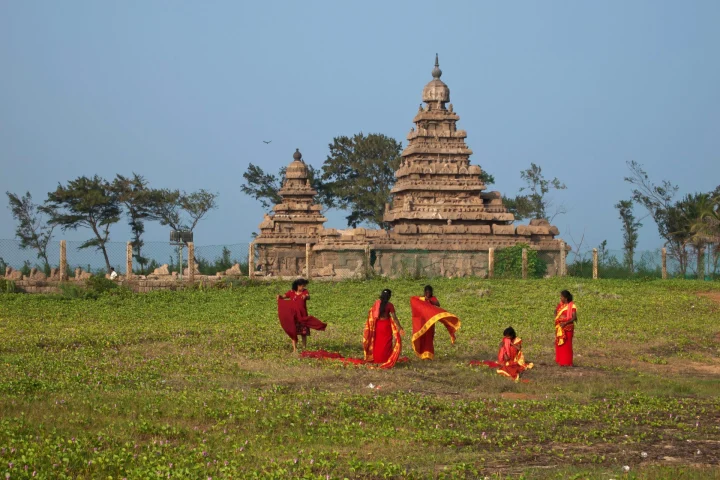
Shore Temple
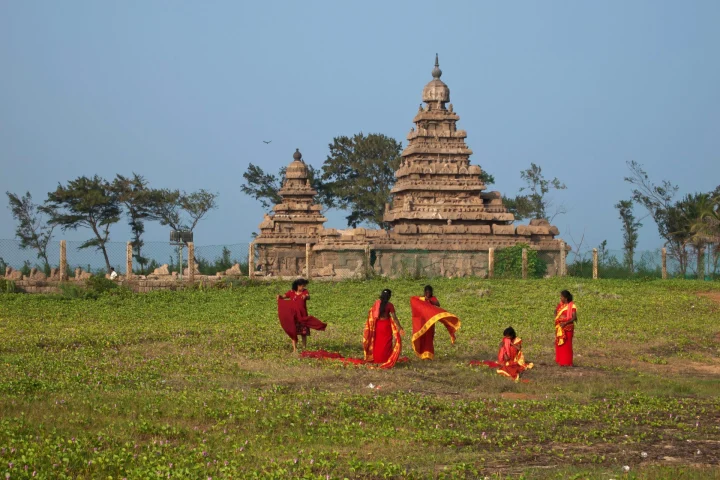
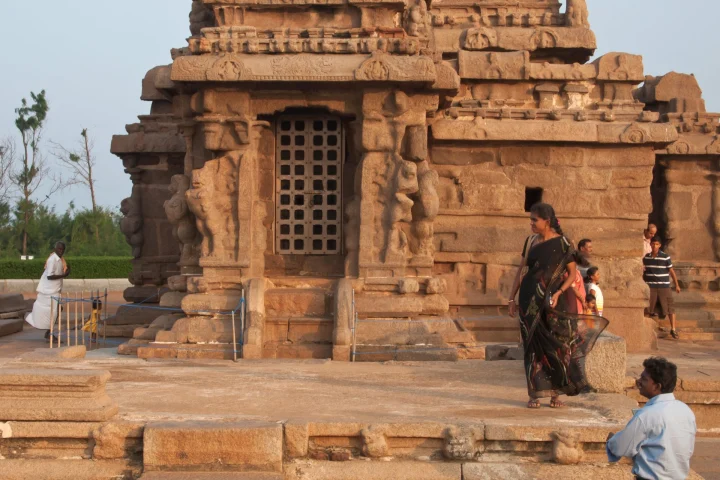
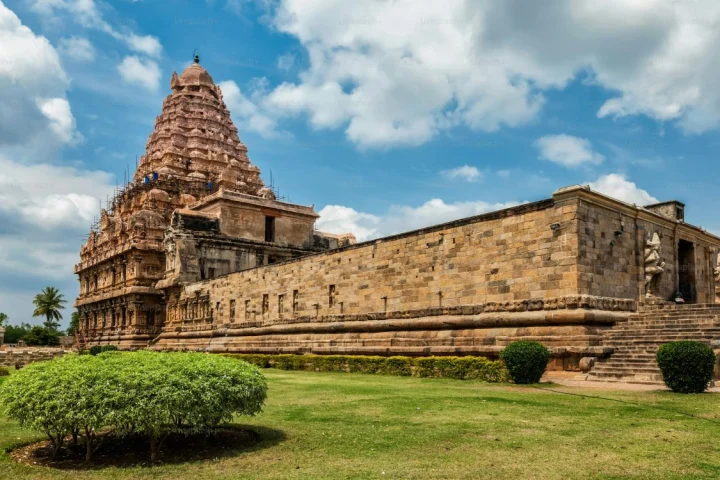
Built in the early 8th century under Rajasimha, the Shore Temple is a small complex of shrines to Shiva and Vishnu standing right on the beach. Salt wind has softened the carving, which gives it its weathered look. Come early, when the light is low and the site is quiet.
Pancha Rathas (Five Rathas)
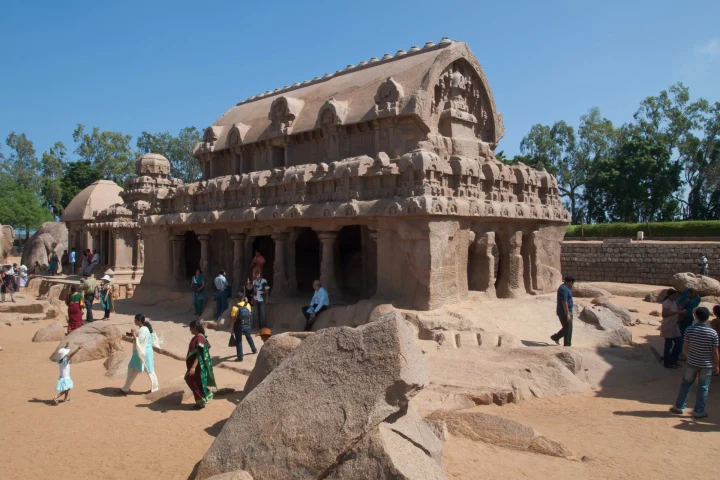
Five monolithic temples, each cut from a single rock and named after the Pandava brothers and Draupadi from the Mahabharata, stand together with carved elephant, lion and bull figures. Each ratha shows a different roof form, like a sculptor’s catalogue of designs.
Arjuna's Penance and the hill monuments
This vast relief carved across two boulders shows gods, people and animals gathered around a natural cleft – read either as Arjuna’s penance or as the descent of the Ganga. Close by are the Krishna Mandapa, the Varaha and Mahishasuramardini cave temples, the balancing boulder known as Krishna’s Butter Ball, and the lighthouse hill with the old Olakkanesvara temple on top.
Tiger Cave and beyond
A few kilometres north at Saluvankuppam, the Tiger Cave is a rock-cut shrine framed by carved tiger-like heads, set in a quiet beach-side park. Sculpture workshops along the main roads continue the stone-carving tradition, and you can watch craftsmen at work.
One-day plan from Pondicherry
With an overnight stay, you can add Kanchipuram, about an hour and a half inland, on the second day. That is exactly what our Mahabalipuram and Kanchipuram heritage tour covers, and it can be extended to Chennai.
- 6:00 am – leave Pondicherry and drive up the ECR.
- 8:00 am – Shore Temple while it is cool and uncrowded.
- 9:30 am – Arjuna’s Penance, Krishna’s Butter Ball and the cave temples.
- 11:30 am – Five Rathas.
- 1:00 pm – seafood lunch near the beach.
- 3:00 pm – Tiger Cave at Saluvankuppam, then drive back, reaching Pondicherry by early evening.
How to reach Mahabalipuram from Pondicherry
The East Coast Road runs almost the whole way along the coast, past salt pans, fishing villages and the backwaters near Marakkanam. It is a two-lane highway with steady traffic but few towns, so the drive is straightforward. With a car and driver you can start before sunrise and reach the Shore Temple while the light is still soft, then move freely between the monuments, which are spread over a couple of kilometres, and the Tiger Cave to the north.
Government and private buses between Pondicherry and Chennai stop at Mahabalipuram, but then you are dependent on autos inside the town and the last buses back in the evening. If you want to do the trip on two wheels instead, our sister site aurobeach.com rents scooters in Pondicherry – though in summer the ride back is hot.
Best time and weather
November to February is the most pleasant season, with mild mornings and fewer hot afternoons. Heavy rain is likely between October and December with the northeast monsoon. From April to June the rock surfaces get very hot by midday, so start at dawn and rest in the afternoon.
Tamil Nadu Tourism holds the Mamallapuram Dance Festival around December and January, with classical dance performed in front of the monuments – check the official dates each year.
Tickets and timings
The monuments are managed by the Archaeological Survey of India and are open from 6 am to 6 pm. At the time of writing, one ticket covers the main ticketed sites, including the Shore Temple and the Five Rathas: ₹40 for Indian citizens and visitors from SAARC and BIMSTEC countries, ₹600 for other foreign nationals, and free for children under 15. Arjuna’s Penance and the hill monuments are in open areas. Keep your ticket for the day, and check current fees on the ASI website before you go.
Food and local specialities
Mahabalipuram is a fishing town, and the beach-side restaurants serve the day’s catch – fish, prawns and squid grilled or cooked in a Tamil masala. Vegetarian meals and South Indian breakfasts are easy to find near the bus stand. The town’s other speciality is stone: small granite and soapstone sculptures from the local workshops make good souvenirs.
Practical tips
- Wear a hat and good sandals; much of the site is exposed rock with little shade.
- Carry water, and avoid the hottest hours between noon and 3 pm in summer.
- The sea here has strong currents – paddling is fine, swimming is risky.
- Local guides wait near the main monuments; agree on the fee before you start.
- Drones need permission at protected monuments, so leave them in the car.
Frequently asked questions
How far is Mahabalipuram from Pondicherry?
About 96 km by the East Coast Road, which usually takes around two hours.
Is one day enough for Mahabalipuram?
Yes. One day is enough for the Shore Temple, Five Rathas, Arjuna’s Penance, the cave temples and the Tiger Cave. Stay overnight only if you want to add Kanchipuram or Chennai.
What are the Mahabalipuram monument timings?
The ASI-managed monuments are open from 6 am to 6 pm. Early morning is the best time for cooler weather and good light.
Does one ticket cover the Shore Temple and Five Rathas?
At the time of writing, a single ASI ticket covers the main ticketed monuments for the day, including both. Keep it with you.
Who built the Mahabalipuram monuments?
They were created under the Pallava dynasty, mainly in the 7th and 8th centuries, with major work under Narasimhavarman I and Rajasimha.