A Rameswaram Dhanushkodi trip takes you to the far south-eastern tip of Tamil Nadu: an island temple town reached by a long sea bridge, and a sand spit that ends at Arichal Munai. From Pondicherry it is a long drive, so it works best as a 2–3 day itinerary. This guide covers the route, the Ramanathaswamy Temple, the Pamban bridges, Dhanushkodi and how to combine the trip with Madurai.
On this page
- Getting there: route and drive time from Pondicherry
- Ramanathaswamy Temple: corridors, theerthams and darshan tips
- The Pamban bridges: old, new and the road bridge
- Dhanushkodi and Arichal Munai
- APJ Abdul Kalam National Memorial
- Suggested Rameswaram Dhanushkodi itinerary, best season and Madurai
- Plan your Rameswaram trip with us
- Frequently asked questions
Getting there: route and drive time from Pondicherry
Rameswaram is about 430 km from Pondicherry by road. Our distance chart lists 429 km and about 8 to 9 hours of driving, without stops. Realistically, that is a full day in the car, so start early and plan meal breaks.
For a Rameswaram Dhanushkodi trip, the drive runs south through the Cauvery delta and Ramanathapuram district, then crosses from Mandapam on the mainland to Rameswaram island over the Pamban road bridge. Many travellers break the journey with a night in Thanjavur, Chettinad or Madurai rather than driving straight through.
- By car with driver: the easiest option for a family or group, and it lets you visit Dhanushkodi at your own pace. Our South India road trip tips cover drivers, breaks and packing.
- By train: with the new Pamban rail bridge open, trains reach Rameswaram again. A Rameswaram–Tambaram (Chennai) service was flagged off when the bridge opened in April 2025. Check current schedules on the Indian Railways website before planning around a train.
- Break the journey: a stop at Chettinad (Karaikudi) or Thanjavur splits the drive into two easier halves.
Ramanathaswamy Temple: corridors, theerthams and darshan tips
The Ramanathaswamy Temple is dedicated to Shiva and is one of the twelve Jyotirlinga shrines and one of the four Char Dham pilgrimage sites. Tradition holds that Rama worshipped Shiva here; the sand linga (Ramalingam) is the main deity, and the Vishvalingam, said to have been brought by Hanuman, is worshipped first.
The corridors
The temple is famous for its pillared corridors, which together run to about 3,850 feet (around 1,170 m). The outer corridor alone has roughly 1,212 pillars and is often called one of the longest temple corridors in the world. Much of the temple was built under the Sethupathi rulers of Ramanathapuram; the third corridor dates from the late 18th century.
The 22 theerthams
Inside the temple there are 22 theerthams, wells and small tanks that pilgrims bathe in, one after another, before darshan. Many pilgrims first take a dip at Agni Theertham, the sea in front of the temple. Temple staff draw water from each well and pour it over you, and the full round takes time on busy days.
| Activity | Timings at the time of writing (official temple site) |
|---|---|
| Temple open | 4 am–1 pm and 3 pm–8 pm |
| Spatika Linga darshan | 5 am–6 am (first darshan of the day) |
| Bathing in the 22 theerthams | 5.30 am–12.30 pm and 3 pm–7 pm |
These hours can change on festival days, so check the official temple website before you go.
Practical darshan tips and dress
- Dress modestly and traditionally; see our temple dress code guide.
- If you plan to bathe in the theerthams, carry a full change of dry clothes, a small towel and a plastic bag for wet clothes.
- Keep valuables to a minimum and follow any rules on phones and cameras posted at the entrance.
- Early morning is calmer than late morning, when tour groups arrive; weekends and festival days are busiest.
The Pamban bridges: old, new and the road bridge
Rameswaram island is joined to the mainland by two bridges side by side over the Palk Strait, and the Pamban Bridge view is one of the highlights of the trip.
- The old rail bridge (1914): often called India’s first sea bridge, it opened in February 1914, with a Scherzer rolling lift span that opened for ships. Rail traffic over it was stopped permanently in December 2022, and dismantling was announced in early 2026.
- The new Pamban rail bridge (2025): opened on 6 April 2025 and described as India’s first vertical-lift railway sea bridge. Its central span, about 72.5 m long, lifts straight up to let vessels pass. The bridge is about 2 km long.
- The road bridge (1988): the Annai Indira Gandhi Road Bridge, about 2.3 km long, opened on 2 October 1988 and is how you will drive onto the island.
On any Rameswaram Dhanushkodi trip by car, the road bridge gives you a good view of both rail bridges. Stopping on the deck may be restricted at times, so follow any police instructions and avoid stopping in the traffic lane.
Dhanushkodi and Arichal Munai
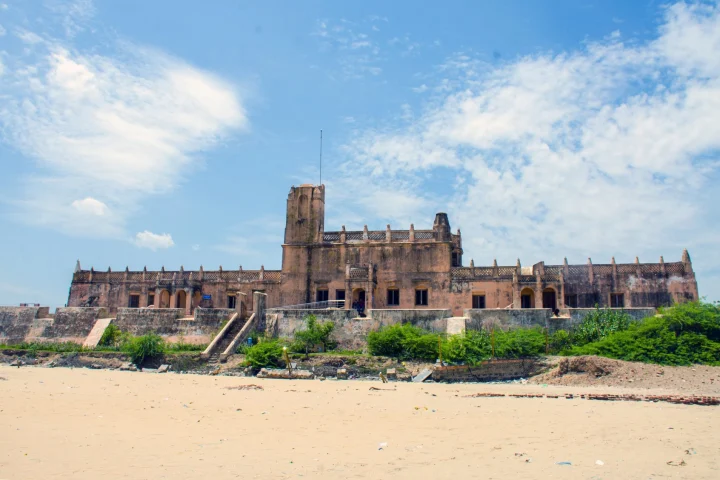
Dhanushkodi was once a busy town with a railway station and a ferry link towards Sri Lanka. On the night of 22–23 December 1964 a severe cyclone struck, with tidal waves estimated at around 7 m. About 1,800 people died, including the passengers of a train on the Pamban–Dhanushkodi line, and the town was later declared unfit for living. Ruins of the church, station and other buildings still stand in the sand.
For decades the last stretch could only be reached by four-wheel-drive vehicles over sand. A road is now complete through to Arichal Munai, where the land ends and the Bay of Bengal meets the Gulf of Mannar. Talaimannar in Sri Lanka lies about 24 km away across the water.
Visiting hours and sea safety
We could not find an official published timing for Dhanushkodi. At the time of writing, visitors are generally expected to leave before dark, and travel reports put the cut-off at around 5–6 pm. Police also close the road when the sea is rough or a swell-surge alert is issued, so check locally on the day before you go.
Tip: Our advice: treat Dhanushkodi as a place to look, not to swim. The sea here can be rough, there are no lifeguards, and facilities are very limited, so carry water and sun protection.
APJ Abdul Kalam National Memorial
Former President A. P. J. Abdul Kalam was born in Rameswaram in 1931. His national memorial at Pei Karumbu, on the way towards Dhanushkodi, was designed and built by the DRDO and inaugurated by the Prime Minister on 27 July 2017. It is a calm, well-kept stop that most travellers fit in on the Dhanushkodi day. Check opening hours locally before you go.
Suggested Rameswaram Dhanushkodi itinerary, best season and Madurai
| Day | Plan |
|---|---|
| Day 1 | Leave Pondicherry early and drive to Rameswaram (or break in Thanjavur or Chettinad). Cross the Pamban road bridge in daylight for the view. |
| Day 2 | Agni Theertham, the 22 theerthams and darshan in the morning. Afternoon at the Kalam memorial and Dhanushkodi; be back before dark. |
| Day 3 | Drive to Madurai for the Meenakshi Amman Temple, then return towards Pondicherry, or stay overnight in Madurai. |
Best season
Most of Rameswaram’s rain falls during the northeast monsoon, roughly October to January, when cyclone alerts can also close Dhanushkodi. In our view, February and March are the most comfortable months, with drier weather and calmer seas; April to June is hot, so plan temple visits early and Dhanushkodi late in the afternoon. See our month-by-month South India guide for more.
Combining the trip with Madurai
Madurai is about 160–175 km from Rameswaram, roughly 3 hours by road along NH 87 through Ramanathapuram, Paramakudi and Manamadurai. That makes it a natural first or last stop. Many visitors plan the loop as Pondicherry → Thanjavur → Rameswaram → Madurai → Pondicherry, which spreads the driving more evenly. If you also want the Chola temples on the way, read our Thanjavur from Pondicherry guide.
Plan your Rameswaram trip with us
A Rameswaram Dhanushkodi trip from Pondicherry involves long drives, early temple starts and weather that can change plans at Dhanushkodi, so it helps to have a flexible route. Have a look at our Madurai, Rameswaram and Kanyakumari tour, or contact us to plan a trip that suits your dates.
Frequently asked questions
How many days do I need for Rameswaram and Dhanushkodi from Pondicherry?
Plan at least 2 days, and 3 if you want to add Madurai or avoid a very long single drive. The drive alone is about 8 to 9 hours each way without stops.
Can I visit Dhanushkodi in the evening?
Visitors are generally expected to leave before dark, and travel reports put the cut-off around 5–6 pm at the time of writing. Police may also close the road in rough weather, so check locally on the day.
Do trains run to Rameswaram now?
Yes. Trains resumed after the new Pamban rail bridge opened on 6 April 2025. Check current schedules on the Indian Railways website before you travel.
Can I bathe in the 22 theerthams without darshan?
Theertham bathing and darshan are separate, but most pilgrims do both in the same morning. At the time of writing the official temple site lists theertham bathing from 5.30 am to 12.30 pm and 3 pm to 7 pm; check before you go.
What is the best time of year for a Rameswaram Dhanushkodi trip?
February and March are usually the most comfortable. Avoid relying on Dhanushkodi during the northeast monsoon, roughly October to January, when rain and rough seas can close the road.