Thanjavur from Pondicherry is one of the most rewarding temple trips you can make in Tamil Nadu. In a single long drive you reach the capital of Rajaraja Chola I, a palace complex with a manuscript library that scholars still use, and workshops that keep three Geographical Indication (GI) crafts alive. This guide covers the drive, what to see and how to turn it into a two-day Chola circuit.
On this page
- Getting to Thanjavur from Pondicherry
- Brihadeeswarar Temple: the Big Temple of Thanjavur
- Thanjavur Maratha Palace and Saraswathi Mahal Library
- Thanjavur crafts: paintings, dolls and the veena
- A 2-day plan: Thanjavur from Pondicherry with the Chola temples
- Plan your Thanjavur trip with us
- Frequently asked questions
Getting to Thanjavur from Pondicherry
By road, Thanjavur is roughly 170–185 km from Pondicherry, depending on the route your driver takes. Our distance chart lists 168 km and about 3.5 to 4 hours of driving, without stops. In practice, allow a little more for breakfast, traffic around Cuddalore and Kumbakonam, and the odd road works.
For Thanjavur from Pondicherry, the usual route heads south along the coast through Cuddalore and Chidambaram, then turns inland across the Cauvery delta via Kumbakonam. This is also the most useful route for sightseeing, because Chidambaram’s Nataraja temple, Gangaikonda Cholapuram and Darasuram all sit on or near it.
- Car with driver: the most flexible option, especially if you want to stop at several temples on one day. See our car with driver page.
- Day trip or overnight: a same-day return is possible but tiring (7–8 hours on the road). One night in Thanjavur or Kumbakonam makes the trip far more relaxed.
- Start early: leaving Pondicherry around 6 am puts you in the delta before the midday heat.
Brihadeeswarar Temple: the Big Temple of Thanjavur
The Brihadeeswarar Temple (also written Brihadisvara, and known locally as the Periya Kovil or Big Temple) was built by the Chola emperor Rajaraja I between 1003 and 1010 CE. He called it Rajarajeshvaram. It is dedicated to Shiva, and it is still a living temple with daily worship.
UNESCO inscribed it as a World Heritage Site in 1987. In 2004 the listing was extended to include the temples at Gangaikonda Cholapuram and Darasuram, and the three together are now called the Great Living Chola Temples.
What to see
- The vimana: the granite tower over the sanctum rises to about 63 m in sixteen storeys. Stand back near the outer wall to take in its full height.
- The Nandi: a huge monolithic seated bull faces the sanctum from its own pavilion. It is often described as one of the largest in India, weighing around 25 tonnes. Look up at the painted ceiling of the pavilion, from the later Nayaka period.
- The linga: the main linga in the sanctum is one of the largest in any Indian temple.
- Gateways and cloister: walk through the two gopurams at the entrance and around the long pillared cloister (prakaram) that encloses the vast courtyard.
- Chola frescoes: paintings from the Chola era survive on the walls of the passage around the sanctum. They were identified in 1931 and are among the best surviving examples of Chola painting.
Best time of day and dress
At the time of writing, the temple is commonly listed as open roughly 6 am–12.30 pm and 4 pm–8.30 pm, but published hours differ, so check before you go. Our advice is to come early in the morning or in the last two hours of daylight. The granite courtyard gets very hot underfoot by noon, and the late afternoon light turns the sandstone-coloured tower gold.
Dress modestly, with shoulders and knees covered. Footwear is left at the counter outside, and photography rules inside the sanctum are strict. Our temple dress code and etiquette guide explains what to expect in Tamil Nadu temples.
Tip: Carry a pair of socks for the walk across the courtyard on hot afternoons; bare stone can be painful by midday.
Thanjavur Maratha Palace and Saraswathi Mahal Library
A short drive from the Big Temple, the Thanjavur Maratha Palace was first built by the Nayak rulers of Thanjavur. It later became the residence of the Bhonsle family of the Thanjavur Marathas, who ruled from 1674 to 1855. The complex is a set of courtyards and halls rather than one building, so budget about two hours.
- Durbar Hall: the old royal audience hall of the palace.
- Royal Palace Museum and art gallery: known for its collection of Chola bronzes and stone sculpture. If you only have an hour, spend it here.
- Raja Serfoji Memorial Hall: a memorial hall named after the scholar-king Serfoji II.
- Bell tower: a tower in the palace grounds, a familiar Thanjavur landmark.
The Saraswathi Mahal Library, inside the palace premises, began as a royal library under the Nayaks. It grew greatly under Serfoji II (1798–1832), who had works collected and copied from many centres of learning. Today it holds over 49,000 volumes, including palm-leaf and paper manuscripts in Tamil, Sanskrit, Marathi and Telugu, plus Persian and Urdu works. Only a small part is on display for visitors.
Each section of the palace complex may have its own ticket and opening hours. At the time of writing these are posted at the gate, so check them there before you go in.
Thanjavur crafts: paintings, dolls and the veena
Thanjavur is one of the best places in South India to buy a craft piece with a clear origin. Several Thanjavur crafts are registered as Geographical Indications, which means the name is legally tied to the region and its traditional methods.
| Craft | What it is | GI status |
|---|---|---|
| Thanjavur painting | Devotional panel paintings known for raised relief work and gold foil | Registered GI (Thanjavur Paintings) |
| Thanjavur doll | The famous bobble-head doll (thalaiyatti bommai) that sways when touched | Registered GI (Thanjavur Doll) |
| Thanjavur veena | The Saraswati veena, traditionally carved from jackwood | Registered GI (Thanjavur Veenai); described as India’s first musical instrument with a GI tag |
| Thanjavur art plate | Metal plates with embossed designs in contrasting metals | Registered GI (Thanjavur Art Plate) |
Ask the seller about the GI logo or the artisan’s details, and ask for a proper bill. If you are buying a painting or a veena, arrange packing for the drive back; our shopping guide has general tips on bargaining and packing.
A 2-day plan: Thanjavur from Pondicherry with the Chola temples
If you can spare a night, this plan for Thanjavur from Pondicherry links all three Great Living Chola Temples with Kumbakonam, and keeps Thanjavur for the second morning, when the Big Temple is at its best. Distances between stops are short: Darasuram is about 40 km from Thanjavur, and Gangaikonda Cholapuram is about 30 km north-east of Darasuram.
| Time | Day 1 | Day 2 |
|---|---|---|
| Morning | Leave Pondicherry early; drive south via Chidambaram to Gangaikonda Cholapuram | Brihadeeswarar Temple soon after opening |
| Midday | Lunch in Kumbakonam; rest through the hottest hours | Thanjavur Maratha Palace, art gallery and Saraswathi Mahal Library |
| Afternoon | Airavatesvara Temple, Darasuram | Craft shopping, then start the drive back |
| Evening | Overnight in Kumbakonam or Thanjavur | Reach Pondicherry by late evening |
Gangaikonda Cholapuram
Rajaraja’s son Rajendra I made Gangaikonda Cholapuram his capital around 1025 CE, and its great Shiva temple was completed around 1035 CE. Today it is a small village near Jayankondam in Ariyalur district, and the temple, second in scale only to Thanjavur, feels much quieter than the Big Temple.
Kumbakonam and Darasuram
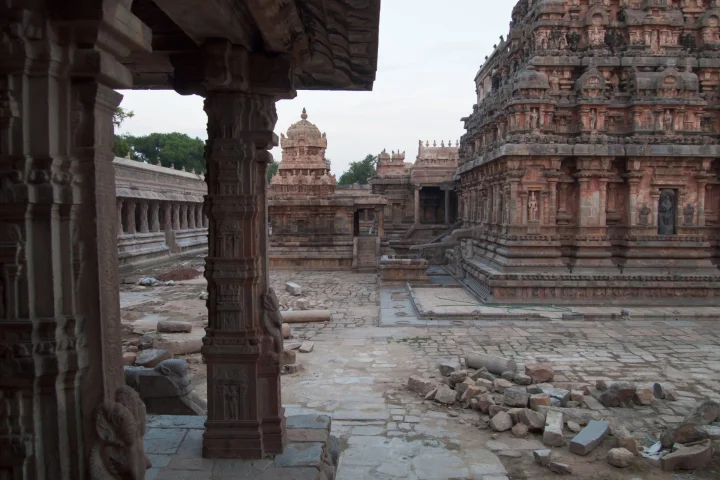
Kumbakonam is the temple town at the heart of the delta and a practical overnight base. On its edge, the Airavatesvara Temple at Darasuram was built by Rajaraja II in the 12th century. Look for the front hall shaped like a stone chariot with wheels and horses, the carved ‘singing steps’, and the friezes of the 63 Nayanar saints.
If you have a third day, add Trichy and Srirangam, or continue south. Our temple circuits comparison shows how this route fits with others, and our Rameswaram and Dhanushkodi itinerary covers the longer trip further south.
Plan your Thanjavur trip with us
Planning Thanjavur from Pondicherry is easier with a driver who knows the delta roads and temple hours. Take a look at our Great Chola Temples tour or the longer Thanjavur, Trichy and Madurai tour, or contact us and we will help you shape a route around your dates.
Frequently asked questions
How far is Thanjavur from Pondicherry by road?
Roughly 170–185 km depending on the route, which usually takes about 3.5 to 4.5 hours of driving without stops. Allow extra time for meals and traffic.
Can I visit Thanjavur from Pondicherry as a day trip?
Yes, but it means 7–8 hours on the road. An overnight stay in Thanjavur or Kumbakonam lets you see the Big Temple in the cooler morning or evening light and add Darasuram and Gangaikonda Cholapuram.
What are the Great Living Chola Temples?
A UNESCO World Heritage listing that covers the Brihadeeswarar Temple in Thanjavur, the Brihadeeswarar Temple at Gangaikonda Cholapuram and the Airavatesvara Temple at Darasuram near Kumbakonam.
What is the best time of day to visit the Brihadeeswarar Temple?
Early morning or late afternoon. The stone courtyard gets very hot by midday, and the tower looks its best in low light. Opening hours vary between sources, so check before you go.