Last updated:
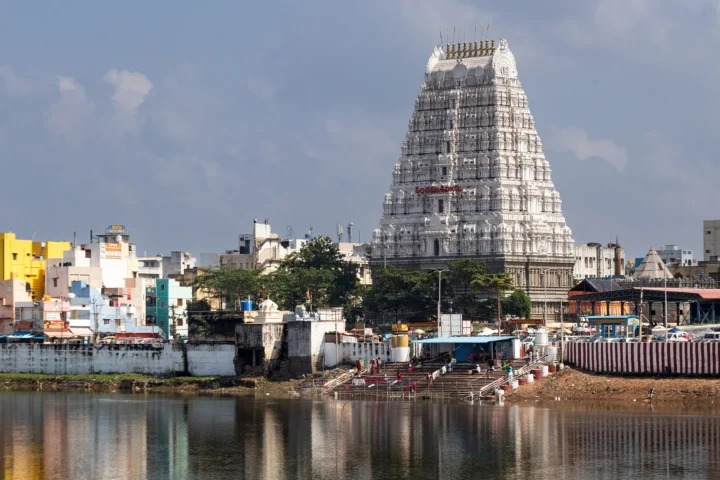
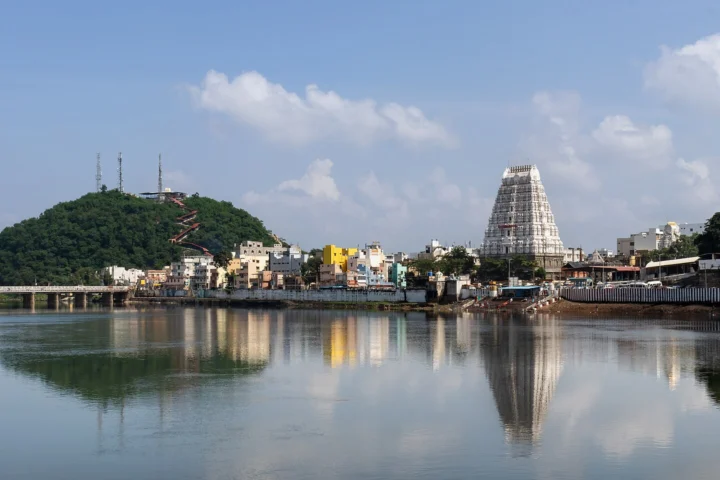
Srikalahasti is a temple town in Tirupati district, Andhra Pradesh, on the banks of the Swarnamukhi river, with rocky hills rising behind it. Its great Shiva temple, the Srikalahasteeswara temple, is one of the Pancha Bhoota Sthalams – the five temples that represent Shiva as the five elements – and stands for vayu, the element of air. It is often called the Kailasa of the South.
For Pondicherry travellers it fits naturally into a trip to Tirupati and Tirumala, less than an hour away, and it completes the set for anyone following the Pancha Bhoota circuit, whose other four temples are in Tamil Nadu.
On this page
The name and the legends
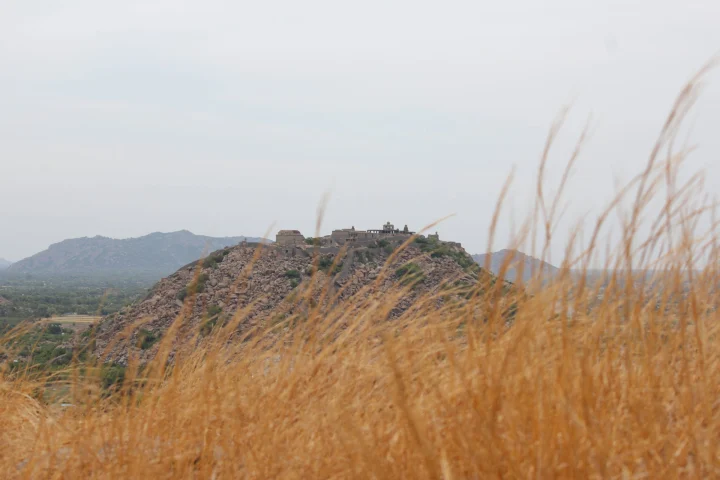
Local tradition explains the name as a combination of Sri (spider), Kala (snake) and Hasti (elephant) – three creatures said to have worshipped the linga here and won liberation. The best-loved story is that of Kannappa, a hunter whose rough but total devotion led him to offer his own eyes when he saw blood flowing from the linga. Shiva stopped him and blessed him. A shrine to Kannappa stands on the hill near the temple, and the legend is retold in Tamil and Telugu devotional literature and in films.
Srikalahasteeswara temple
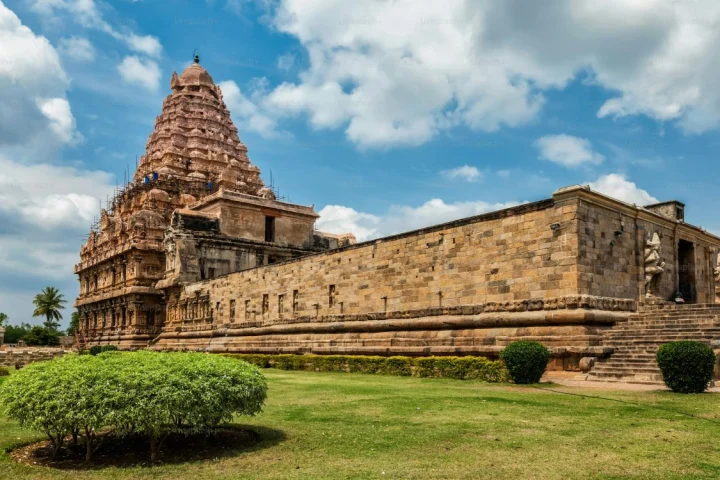
The temple’s origins go back many centuries, with major additions under the Cholas around the 11th century and later under the Vijayanagara kings. The presiding deity is Shiva as Kalahasteeswara, worshipped as a white stone linga, alongside the shrine of the goddess Gnana Prasunambika. It is a Paadal Petra Sthalam, sung in the Tamil Tevaram hymns.
The huge gopuram built by Krishnadevaraya in 1516 collapsed in May 2010; it was rebuilt and reconsecrated in January 2017, and the new tower is once again the town’s landmark. Our Srikalahasteeswara Temple guide covers darshan and practical details.
Rahu-Ketu pooja and eclipses
Srikalahasti is widely known for the Rahu-Ketu pooja, performed by devotees seeking relief from the astrological effects of the two shadow planets. Unusually, the temple stays open during solar and lunar eclipses, when most other temples close. Pooja tickets, timings and rules are managed by the temple administration and change from time to time – check the official temple information or at the counters before you go. We do not book poojas, but can plan your timing around them.
Kalamkari: the town's art
Srikalahasti is one of the two main centres of Kalamkari, the craft of painting textiles with natural dyes. The Srikalahasti style is drawn freehand with a bamboo pen (kalam), usually showing scenes from the epics and temple themes, and Srikalahasti Kalamkari was registered as a Geographical Indication in 2005. Workshops and shops in town sell everything from wall hangings to saree lengths. Look for natural-dye work and ask to see artists drawing if a workshop is open. Browse our food and shopping page for crafts elsewhere in the region.
Best time to visit
October to February is the most comfortable time, with mild days. April to June is very hot in this part of Andhra Pradesh, so visit early in the morning. The north-east monsoon (October to December) can bring heavy rain, and the Swarnamukhi sometimes floods. Weekends, eclipse days and festivals such as Maha Shivaratri bring very large crowds.
How to plan Srikalahasti from Pondicherry
The road route goes north via Tindivanam and Vandavasi to Kanchipuram, then on through Arakkonam and Tiruttani into Andhra Pradesh via Puttur – about 245 km and five to five and a half hours. Interstate permit charges apply for Tamil Nadu tourist cars entering Andhra Pradesh.
Most visitors combine Srikalahasti with Tirupati. Our Andhra temple circuit with Tirupati and Srikalahasti includes both, along with the Chandragiri Fort near Tirupati. For Tirumala darshan itself, see our Tirupati darshan tour; darshan tickets are booked through the official TTD channels, not by us. Pilgrims following the five-element temples can add Srikalahasti to our Pancha Bhoota Sthalam tour.
The Pancha Bhoota Sthalams
- Earth (prithvi): Ekambareswarar temple, Kanchipuram
- Water (jala): Jambukeswarar temple, Thiruvanaikaval near Trichy
- Fire (agni): Arunachaleswarar temple, Tiruvannamalai
- Air (vayu): Srikalahasteeswara temple, Srikalahasti
- Space (akasha): Thillai Nataraja temple, Chidambaram
Sample three-day plan with Tirupati
Because Tirumala darshan slots are fixed in advance and can fall at any hour, it is usually easier to plan Srikalahasti around them rather than the other way round. A relaxed outline looks like this:
If you have booked a Rahu-Ketu pooja, put Srikalahasti on the morning of day 2 or 3 instead, and keep the Tirumala slot as the fixed point of the trip.
- Day 1: Leave Pondicherry early and drive via Kanchipuram and Tiruttani to Srikalahasti; temple visit in the afternoon, then on to Tirupati for the night.
- Day 2: Tirumala darshan at your booked time; in the free half of the day, visit Chandragiri Fort or local temples in Tirupati.
- Day 3: Morning at leisure or a second temple visit, then the drive back to Pondicherry (about 225 km from Tirupati).
Where to stay and eat
Srikalahasti has lodges and simple hotels near the temple, but most travellers stay in Tirupati, which has far more choice and is under an hour away. Vegetarian Andhra meals are easy to find in town. We can help you book a stay in either place.
Practical tips
- Dress conservatively – traditional clothing is expected at the temple; check the current dress rules locally.
- Footwear is left outside; ask at the entrance about rules for phones and bags.
- Start early in summer; the stone floors heat up quickly.
- Allow extra time on weekends, eclipse days and festival days.
- Buy Kalamkari from established workshops and check whether natural dyes are used.
Frequently asked questions
How far is Srikalahasti from Pondicherry?
About 245 km by road via Tindivanam, Kanchipuram, Arakkonam, Tiruttani and Puttur, a drive of five to five and a half hours.
Which element does Srikalahasti represent?
Air (vayu). It is one of the five Pancha Bhoota Sthalams; the others represent earth, water, fire and space.
How far is Srikalahasti from Tirupati?
About 36–38 km, usually under an hour by road, so the two are easily combined.
Is Srikalahasti temple open during an eclipse?
Yes. The temple is known for staying open during solar and lunar eclipses, when most other temples close.
What is Srikalahasti famous for besides the temple?
Kalamkari – hand-drawn, naturally dyed textile art made with a bamboo pen, which holds Geographical Indication status.