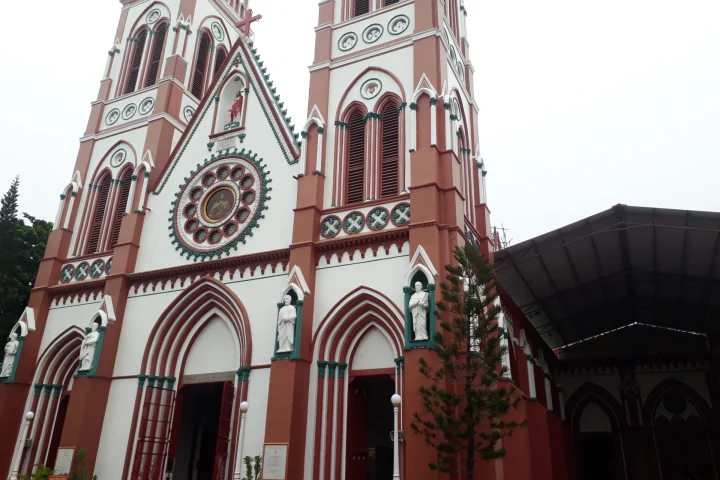
The Immaculate Conception Cathedral is the mother church of the Roman Catholic Archdiocese of Pondicherry and Cuddalore and one of the oldest churches in the town. It stands on busy Mission Street (Cathedral Street) in the old Tamil quarter, a few blocks west of White Town, and is known locally as Samba Kovil, a Tamil rendering of its earlier dedication to Saint Paul.
Compared with the Sacred Heart Basilica it is less photographed, but its story is one of the best windows into Pondicherry’s turbulent colonial history. It is worth 20 minutes if you are exploring the town’s churches or walking between White Town and the market.
On this page
History: a church rebuilt three times
Jesuit missionaries arrived in the French settlement of Pondicherry in 1689. With the support of King Louis XIV they built their first church here in 1692, but it was demolished the following year when the Dutch captured the town.
A second church went up in 1699, and a larger third one was built between 1728 and 1736. That church was razed by the British in 1761, during the Seven Years’ War, when they took and levelled much of Pondicherry.
The present building was completed and consecrated by Bishop Champenois on 20 June 1791. A choir loft was added in 1905 and the sanctuary was remodelled in 1970. Mother Teresa is among the well-known visitors the cathedral has received.
What to see
- The façade: a tall white-and-cream front with columns, scrolls and a statue of Mary in a niche, best seen from across the road.
- The nave and altar: a spacious, airy interior with an ornate main altar and side altars.
- Services: the cathedral is an active parish with masses in Tamil and English. Hearing a Tamil hymn here is a memorable part of a visit.
- Festivals: Christmas and the feast of the Immaculate Conception on 8 December are the busiest days.
Timings and entry
Entry is free. The cathedral is generally open from early morning to evening. Mass times differ between weekdays, Sundays and feast days and are displayed at the church, so check there or ask at the parish office. Outside mass times you can walk in quietly and sit.
Best time to visit
Go in the morning or late afternoon. Mission Street is one of Pondicherry’s main shopping roads and gets congested in the evening, especially on weekends, so an earlier visit is easier. Allow 20 to 40 minutes.
Practical tips
- Dress: modest clothing covering shoulders and knees.
- Photography: fine from outside. Inside, no flash, and don’t photograph worshippers or services.
- Etiquette: keep your voice low and phones silent, and don’t walk around during mass.
- Parking: Mission Street is narrow and busy with little parking. Our drivers drop you at the gate and wait on a side street.
- Combine on foot: the cathedral is about a 10-minute walk from Bharathi Park and the Goubert Market.
Nearby places
A church trail in Pondicherry usually covers three buildings: this cathedral, the Gothic Basilica of the Sacred Heart on the South Boulevard, and Our Lady of Angels Church near the sea. Between them lie the streets of White Town, the Pondicherry Museum and the Ananda Ranga Pillai Mansion.
Visiting on a tour
We include the cathedral on our Pondicherry local sightseeing day on request, and it fits well into the heritage and beaches tour. For a longer Christian pilgrimage, ask us about adding Velankanni.
Frequently asked questions
How old is the Immaculate Conception Cathedral in Pondicherry?
The present building was consecrated on 20 June 1791. Earlier churches on the site date back to 1692 but were destroyed by the Dutch in 1693 and the British in 1761.
Why is the cathedral called Samba Kovil?
Samba Kovil is a Tamil form of the church’s earlier dedication to Saint Paul. Kovil means temple or place of worship in Tamil.
Is there an entry fee for the Immaculate Conception Cathedral?
No. Entry is free, and visitors of all faiths are welcome if they dress modestly and stay quiet.
Where is the Immaculate Conception Cathedral?
On Mission Street (Cathedral Street) in central Pondicherry, a short walk west of White Town and Bharathi Park.