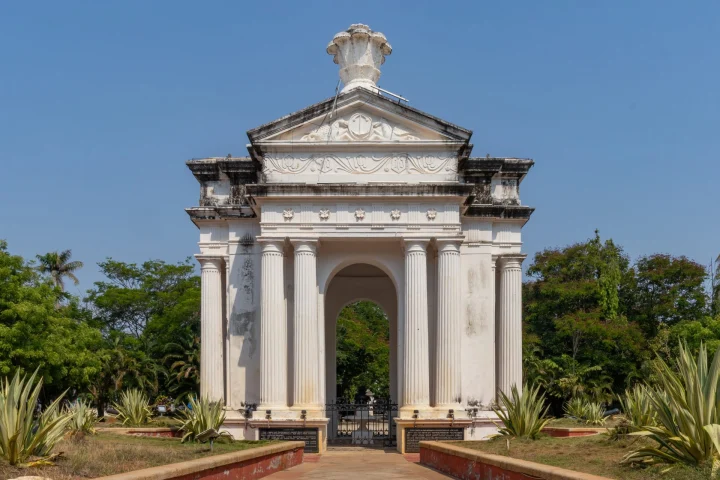
The French War Memorial, known in French as the Monument aux Morts, stands on Goubert Avenue, the seafront road of Pondicherry, a few steps south of the Gandhi statue. It honours the men of French India who died for France in the First World War.
It is a small monument that most people pass during an evening stroll on Promenade Beach, but it deserves a closer look. Few places in India so directly recall the part Indian soldiers from the French settlements played in Europe’s wars.
On this page
History of the memorial
Pondicherry and the other French Indian settlements sent recruits to fight for France in 1914–18. Around 500 combatants from Pondicherry served overseas, and about 75 of them were killed.
The memorial was built in 1937 with money from the colonial budget, designed by the sculptor Gaston Petit and an architect named Delafon. It was unveiled on 3 April 1938 by the Governor of French India, Horace Valentin Crocicchia. Later plaques added the names of soldiers from the region who died in the Second World War, the First Indochina War and the Algerian War.
The memorial remains the property of the French government, and French diplomats and veterans still take part in the ceremonies held here.
What to see
- The monument: four tall white pillars rising behind an inscribed stone panel, with the small figure of a soldier in front, set back in a gated garden enclosure facing the sea.
- The plaques: bronze plaques bearing the names of the fallen from the First World War, with later plaques for subsequent conflicts.
- Ceremonies: on 14 July (Bastille Day) the memorial is decorated and illuminated, and on 11 November a remembrance ceremony marks the end of the First World War, attended by officials and students.
Timings and entry
There is no entry fee and you can see the memorial from the promenade at any hour. The gates of the enclosure are usually kept closed outside official occasions, so most visitors view it through the railings. Beach Road is closed to vehicles in the evening and early morning (at the time of writing roughly 6 PM to 7:30 AM), which is the most pleasant time to walk up to it.
Best time to visit
Early morning offers good light and an empty promenade. If you are in Pondicherry on 14 July, come in the evening to see the memorial lit up, when Pondicherry’s French community marks the day. Fifteen to twenty minutes is plenty, as part of a longer seafront walk.
Practical tips
- Respect: this is a war memorial. Don’t climb the railings or sit on the steps, and keep noise down during ceremonies.
- Photography: fine from the promenade. During official ceremonies, follow instructions from organisers and police.
- Parking: no vehicles on Beach Road in the evening. Park in a White Town street and walk a block east.
- Heat: there is no shade near the monument at midday.
Nearby places
The memorial sits in a cluster of seafront landmarks: the Gandhi statue and the Old Lighthouse are just to the north, and Our Lady of Angels Church is a short walk inland along Rue Dumas. Bharathi Park and the Pondicherry Museum are five minutes away through White Town.
Visiting on a tour
The memorial is a stop on our Pondicherry local sightseeing day and the heritage and beaches tour. For history lovers, we can build a day around colonial Pondicherry with the museum, Arikamedu and the White Town streets.
Official information: Incredible India (Ministry of Tourism)
Frequently asked questions
Who does the French War Memorial in Pondicherry honour?
Soldiers from French India who died for France in the First World War. Later plaques added those who died in the Second World War, the First Indochina War and the Algerian War.
When was the French War Memorial built?
It was built in 1937 and unveiled on 3 April 1938 by Governor Horace Valentin Crocicchia.
When is the French War Memorial illuminated?
Every year on 14 July, Bastille Day. A remembrance ceremony is also held on 11 November.
Can you go inside the French War Memorial?
The enclosure is usually closed outside ceremonies, but the monument is easily seen from the promenade at any time, free of charge.