Last updated:
Jalagamparai is the main waterfall near Yelagiri, the small hill station in Tirupattur district. The Attaru river, which drains the valleys of the Yelagiri hills, tumbles over broad granite slabs and boulders in a series of drops. It is not a tall single plunge – reports put the main drop at around 15 metres – but in a good season the white water spread over the rocks, with dry deciduous forest all around, is a fine sight.
There are two very different ways to get there, and choosing the right one is the key to a good visit.
On this page
Two ways to reach Jalagamparai
By road from the Tirupattur side
The falls lies at the foot of the hills, about 13 km from Tirupattur town. A motorable road leads close to the falls from this side, followed by a short walk of a few minutes. By road from Yelagiri town it is a longer drive of about 37 km, because you have to come down the ghat and go round the hills. This is the easy option for families and older travellers.
On foot from Yelagiri: the guided trek
The Tamil Nadu Forest Department runs Jalagamparai as one of its official trails under Trek Tamil Nadu. At the time of writing it is listed as a moderate, 8 km round trip (4 km each way) that takes about five hours, starting from Yelagiri and following the stream down through dry deciduous forest to the falls. The trek fee covers the permit, a forest guide and insurance, and slots must be booked online in advance. The forest department lists it as a birding trail, with peafowl, grey junglefowl and minivets, and also warns that snakes such as Russell’s viper and cobra live in the area.
When the falls has water
Jalagamparai depends on monsoon rain. It is usually at its best from about November to February, after the north-east monsoon, and it often dries up almost completely in the summer months. If you visit in April or May, you may find bare rock with only small pools. Rainfall varies a lot from year to year, so ask us about current conditions before you go if the falls is the main purpose of your trip.
Safety and rules
The rock slabs around the falls are smooth and very slippery when wet, and the pools have uneven depths. On the guided trek, the forest department’s rules say bathing in the falls is prohibited. Whichever way you come, treat the water with caution:
- Stay off the wet slabs at the top of the drops and do not climb the rock face.
- Do not enter the water when the flow is strong or rising after rain.
- Carry water and snacks; facilities near the falls are basic.
- Take all plastic and litter back with you.
- Leave well before dusk; this is a forest area.
Temple and the Yelagiri connection
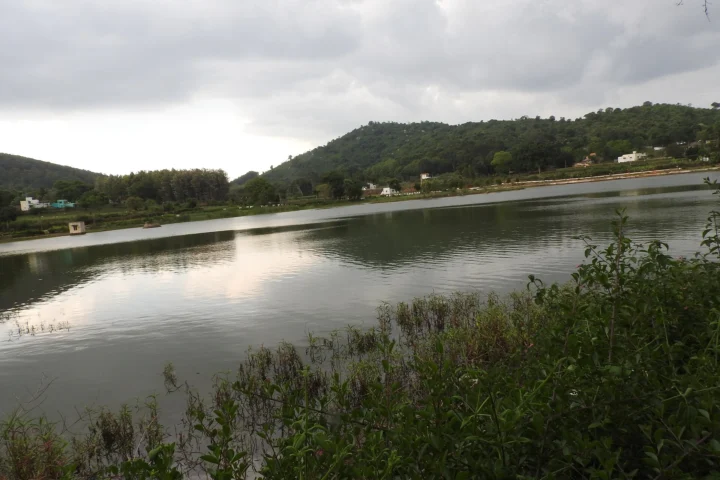
Close to the falls there is a Murugan temple housed in a building shaped like a lingam, which draws pilgrims as well as picnickers on festival days and weekends. Back on top of the hills, you can combine the falls with Punganoor Lake, the nature park and the viewpoints along the 14 hairpin bends of the Yelagiri ghat road.
Visiting from Pondicherry
Yelagiri is about 241 km from Pondicherry, roughly 5 to 6 hours by road. If you want to see Jalagamparai by road, the easiest plan is to stop at the falls via Tirupattur on the way up or down the hills. Our Hogenakkal and Yelagiri weekend can include it with a car and driver; if you prefer the trek, book your Trek Tamil Nadu slot first and we will plan the drive around it. For more ideas, see our waterfalls page.
Frequently asked questions
How do you reach Jalagamparai Falls?
Either by road from the Tirupattur side (about 13 km from Tirupattur, then a short walk) or on the forest department’s guided trek from Yelagiri, an 8 km round trip booked on trektamilnadu.com.
When is the best time to see Jalagamparai Falls?
From about November to February, after the monsoon. The falls often dries up in summer.
Is bathing allowed at Jalagamparai?
On the guided trek, the forest department’s rules prohibit bathing in the falls. The rocks are slippery and pools uneven, so stay out of the water when the flow is strong.
How long is the Jalagamparai trek?
At the time of writing, Trek Tamil Nadu lists it as a moderate 8 km round trip taking about five hours with a forest guide.