Last updated:
Belur and Halebidu are two small towns in Hassan district, western Karnataka, about 16 km apart. Eight to nine hundred years ago they were at the heart of the Hoysala kingdom: Belur an early royal centre, and Halebidu – then called Dwarasamudra – its capital. The temples the Hoysalas built here are among the most richly carved buildings anywhere in India.
In 2023 UNESCO inscribed the Sacred Ensembles of the Hoysalas – the Chennakeshava temple at Belur, the Hoysaleswara temple at Halebidu and the Keshava temple at Somanathapura near Mysore – as a World Heritage Site. For travellers from Pondicherry they make a rewarding, if long, road trip into Karnataka, best combined with Shravanabelagola, Mysore or the coffee hills of Chikmagalur.
On this page
What makes Hoysala temples special
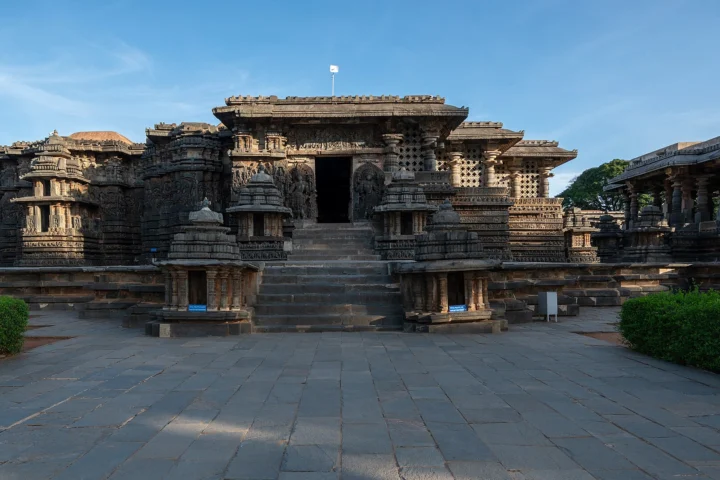
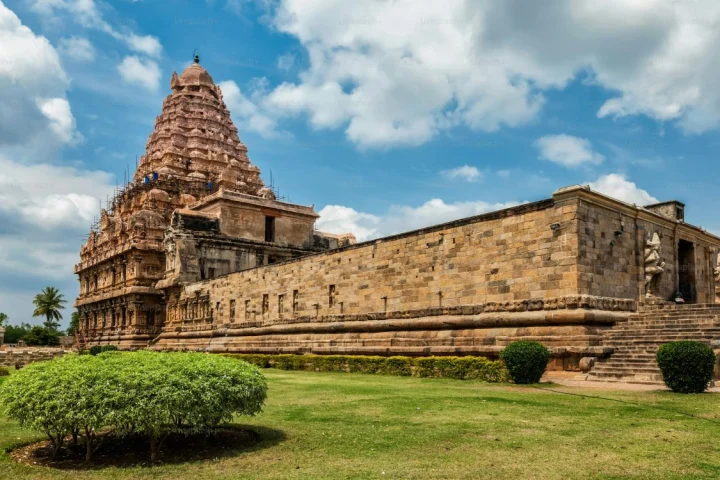
Hoysala builders worked in chloritic schist, often called soapstone, which is soft enough when freshly quarried to be worked in fine detail. That allowed carving of astonishing fineness: jewellery on figures, layered friezes of elephants, horses and epic scenes, and pierced stone screens. The temples typically stand on a raised platform (jagati) with a star-shaped plan, so walls are broken into many angles that catch the light. UNESCO highlights how the style blends elements from northern, southern and Deccan temple traditions.
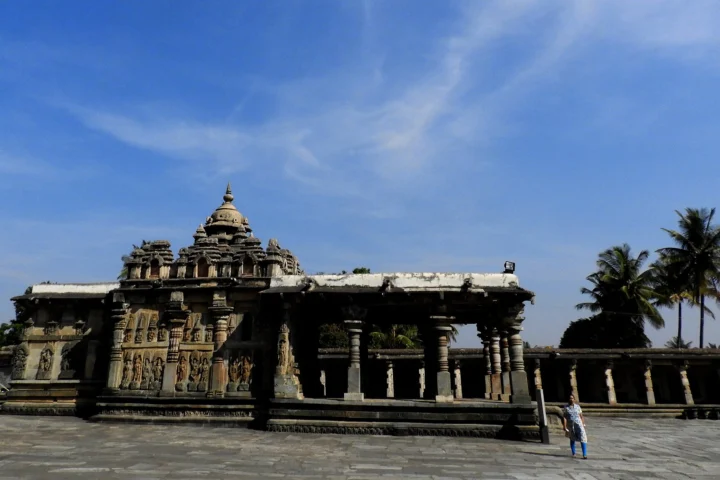
Chennakeshava temple, Belur
King Vishnuvardhana commissioned the Chennakeshava (Vijayanarayana) temple in 1117, on the banks of the Yagachi river. According to its history it took about a century and three generations to complete. It is still a living Vaishnava temple, with daily worship. Inside the walled complex, the main temple is surrounded by smaller shrines, including the Kappe Chennigaraya temple built at the same time by the queen.
Look for the madanikas – graceful bracket figures of dancers and musicians under the eaves – of which 38 survive, the 48 ornate pillars of the central hall, and the friezes from the Ramayana, Mahabharata and Puranas. Around 118 inscriptions have been recorded in the complex. Our Chennakeshava Temple guide covers what to look for.
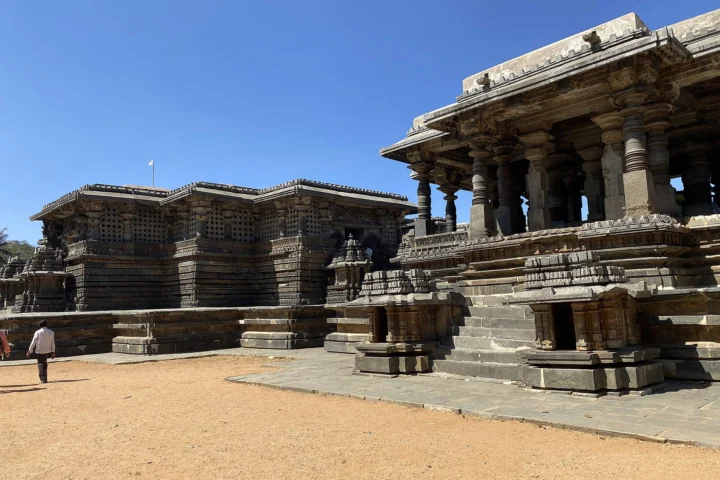
Hoysaleswara temple, Halebidu
The Hoysaleswara temple was begun around 1121 under Vishnuvardhana, with an officer named Ketamalla overseeing the work. It is a twin temple, with two equal Shiva sanctums named Hoysaleswara and Shantaleswara, after the king and queen, each faced by its own Nandi pavilion. Its outer walls carry around 340 large relief panels above bands of friezes – some of the finest narrative carving of the period.
Halebidu, whose name means “old city”, paid the price of being a capital: it was attacked by Delhi Sultanate armies in the early 14th century and again in 1326, and the city fell into ruin. The temple survived, unfinished in parts. An archaeological museum near the temple holds sculpture from the area. See our Hoysaleswara Temple guide for details.
More at Halebidu
Nearby are the three-shrined Kedareshwara temple, with its own fine reliefs, and a group of Jain basadis, a reminder that the Hoysala capital supported Jain as well as Hindu worship. The old reservoir that the Hoysala city was built beside still lies close to the temples.
Shravanabelagola on the way
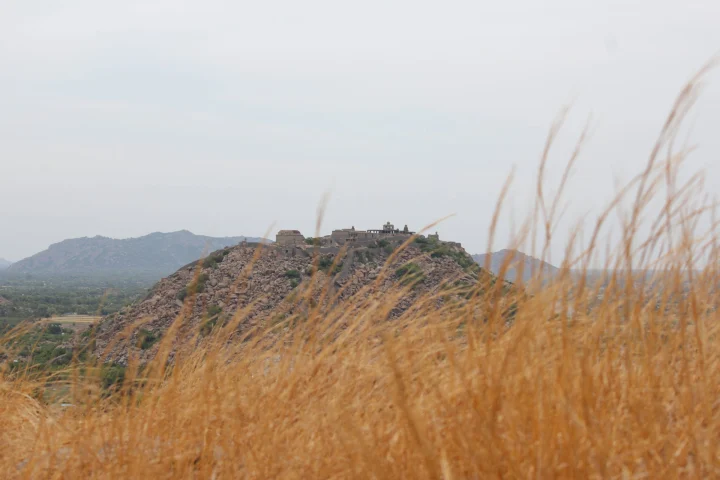
If you approach from Bengaluru, Shravanabelagola is only a short detour, about 11 km south-east of Channarayapatna. On Vindhyagiri hill stands the 58-foot monolithic statue of Gommateshwara (Bahubali), one of the most important Jain pilgrimage sites in India; an inscription at its base dates from 981 CE. Reaching the statue means climbing several hundred rock-cut steps barefoot, so go early before the stone heats up.
Best time to visit
October to February is ideal, with dry, mild weather that suits walking around the temples. March to May is hot by midday, so visit early and late. The south-west monsoon (June to September) brings rain to this part of Karnataka, but the green countryside and soft light can be lovely between showers. Morning light is best for photographing the carving at both sites.
How to plan Belur and Halebidu from Pondicherry
The usual route runs north-west via Tindivanam and Krishnagiri, skirts Bengaluru, then follows the Hassan highway west through Kunigal and Channarayapatna. At around 550 km, it is best split with a night in Bengaluru or Hassan. Interstate permit charges apply for Tamil Nadu tourist cars entering Karnataka.
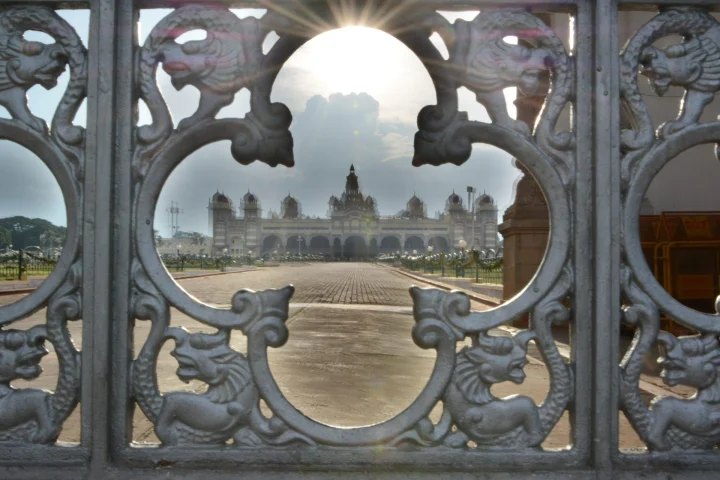
Our Hoysala temples and Mysore tour combines Belur and Halebidu with Shravanabelagola and Mysore, including the Mysore Palace and the third Hoysala site at Somanathapura. Coffee lovers can continue to Chikmagalur instead; see our Coorg and Chikmagalur coffee trail.
Sample plan for the temple day
- Start early at Belur, when the light is soft and the temple quiet; allow two to three hours.
- Drive about 16 km to Halebidu for lunch and the Hoysaleswara temple, museum and Kedareshwara temple.
- Visit the Jain basadis in the late afternoon, then return to Hassan or continue towards Mysore or Chikmagalur.
Guides and visiting tips
The carving is so dense that a knowledgeable guide transforms the visit. Guides are often available at the entrances; agree the fee and duration before you start. Timings, ticketing and photography rules are set by the temple authorities and the Archaeological Survey of India and can change – check locally at the time of your visit.
Practical tips
- Wear modest clothing; Belur is an active temple.
- Footwear is left outside the temples – carry socks for hot stone.
- Bring a small torch or use your phone light to see carving in darker interiors.
- Hassan has the widest choice of hotels; options in Belur and Halebidu are more limited.
Frequently asked questions
How far are Belur and Halebidu from Pondicherry?
About 550 km by road via Krishnagiri, Bengaluru and Hassan, nine to ten hours’ driving. Most travellers break the journey for a night.
How far is Halebidu from Belur?
About 16 km, around half an hour by road, so both temples are easily seen in one day.
Are Belur and Halebidu UNESCO World Heritage Sites?
Yes. In 2023 they were inscribed, together with the Keshava temple at Somanathapura, as the Sacred Ensembles of the Hoysalas.
Who built the Belur temple?
The Hoysala king Vishnuvardhana commissioned the Chennakeshava temple at Belur in 1117.
How many days do I need for Belur and Halebidu?
One full day covers both temples. Add a day each for Shravanabelagola, Mysore or Chikmagalur, plus travel days from Pondicherry.