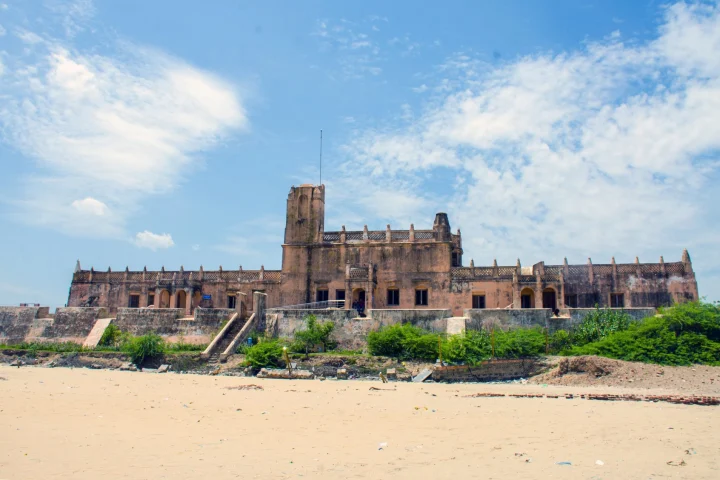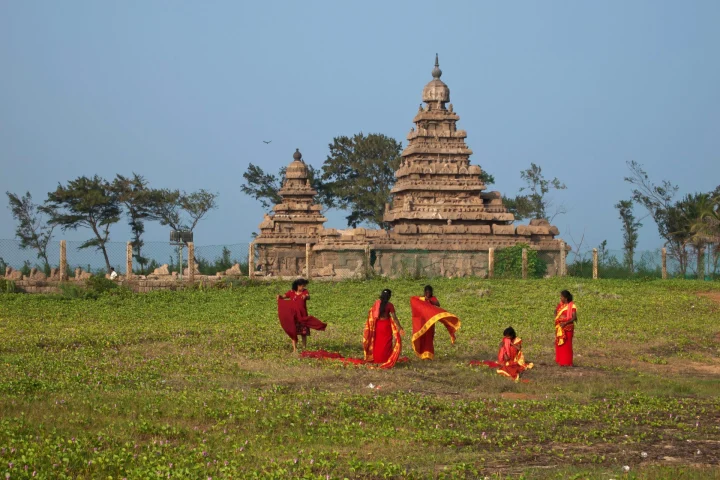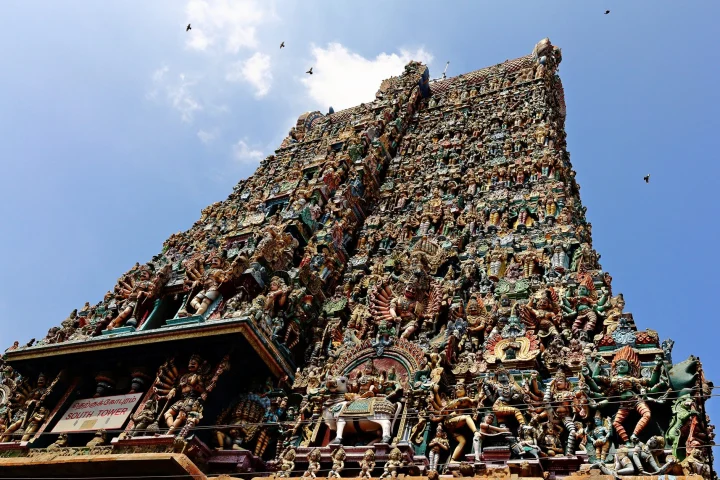
Hampi is the ruined capital of the Vijayanagara Empire, which ruled much of South India from the 14th century until 1565, when the city was sacked and abandoned after the empire’s defeat in battle. What remains is spread across a landscape of granite boulders and banana fields beside the Tungabhadra river: around 1,600 surviving monuments over more than 4,000 hectares. UNESCO inscribed the Group of Monuments at Hampi as a World Heritage Site in 1986.
It is a long way from Pondicherry, but for anyone interested in South Indian history it rounds off the story told by the temples of Tamil Nadu. This guide covers the route, how many days to allow, what to see and when to go.
On this page
How to get to Hampi from Pondicherry
By road, Hampi is roughly 650 km from Pondicherry, usually driven via Krishnagiri and Bengaluru and then north-west on the highway towards Hosapete. Online route planners give anywhere from about 645 to 675 km depending on the exact route. Pure driving time is around 11 to 13 hours, which is too much for one day, so break the journey – Bengaluru is roughly halfway and makes a sensible overnight stop.
The base for Hampi is either Hampi village itself, close to the Virupaksha Temple, or the town of Hosapete (Hospet), about 13 km away, which has more hotels. Hosapete Junction is also the nearest railway station if part of your group prefers to travel by train.
A car registered in Tamil Nadu or Puducherry pays interstate permit charges on entering Karnataka; any quote should include this.
How many days do you need?
Allow at least two full days in Hampi. One day covers the highlights at a rush; two let you see the sacred centre, the royal centre and the Vittala Temple at a sensible pace, with time for a sunrise or sunset viewpoint. A third day adds Anegundi across the river, the museum and a slower look at the lesser-known temples.
Counting the drive, that makes a trip of five to six days from Pondicherry: a day and a half each way with a night in Bengaluru, plus two or three days on site. Our Hampi Heritage Tour is built around this pattern.
What to see in Hampi
The sacred centre: Virupaksha Temple and Hemakuta Hill
The Virupaksha Temple at the end of Hampi Bazaar is the oldest shrine at the site and still an active place of worship, with an entrance tower around 50 metres high. Just above it, Hemakuta Hill has more than 30 small temples, some older than the Vijayanagara period, and a lovely view at sunset. Nearby are the two giant monolithic Ganeshas known as Sasivekalu and Kadalekalu, the huge Lakshmi Narasimha monolith and the Badavilinga shrine, whose lingam stands in water.
The Vittala Temple
The Vittala Temple is Hampi’s showpiece. Its courtyard holds the famous stone chariot, actually a shrine to Garuda, and its main hall is known for the ‘musical pillars’ – slender carved columns that ring when tapped (tapping is no longer allowed, to protect them). Private vehicles stop about 2 km short of the temple; from there you walk or take the battery-operated vehicles. Go early in the morning, before the tour groups.
The royal centre
South of the sacred centre are the remains of the palace area. The Mahanavami Dibba is a tall stone platform with carved friezes, beside a beautifully restored stepped tank. Nearby are the Hazara Rama Temple, whose walls are covered in Ramayana panels, the Zenana Enclosure with the Lotus Mahal, the long row of domed Elephant Stables and the Queen’s Bath. The Lotus Mahal and Queen’s Bath show the Indo-Islamic influence that makes Hampi’s architecture distinctive.
Viewpoints, the river and Anegundi
Matanga Hill is the classic sunrise climb, with a view over the whole site; go with company and a torch, as the path is rocky. Across the Tungabhadra, the village of Anegundi and Anjanadri Hill – believed by many to be the birthplace of Hanuman – are reached by road via a bridge or, when it runs, a coracle or boat crossing. River crossings are stopped when the water is high.
Archaeological Museum, Kamalapura
The Archaeological Survey of India’s museum at Kamalapura, a few kilometres from the ruins, has sculpture, coins and a model of the site that helps make sense of the layout. At the time of writing it is closed on Fridays.
A sample plan for Hampi
With more time, Mysore or the coffee country of Coorg and Chikmagalur can be added on the way back – see our Coorg & Chikmagalur coffee trail.
- Day 1: Leave Pondicherry early and drive to Bengaluru (overnight).
- Day 2: Drive on to Hampi or Hosapete, arriving mid-afternoon. Sunset from Hemakuta Hill.
- Day 3: Early start at the Vittala Temple, then the riverside path back towards Hampi Bazaar. Afternoon at the Virupaksha Temple, the monolithic Ganeshas and the Lakshmi Narasimha statue.
- Day 4: The royal centre – Mahanavami Dibba, stepped tank, Hazara Rama Temple, Zenana Enclosure, Lotus Mahal, Elephant Stables and Queen’s Bath – then the museum at Kamalapura (not on Fridays).
- Day 5: Sunrise on Matanga Hill or a morning at Anegundi, then drive towards Bengaluru.
- Day 6: Return to Pondicherry.
Best time to visit Hampi
Hampi sits on the dry Deccan plateau, and the rocks soak up heat. October to February is the best season: clear, sunny days and cool mornings. From March the temperature rises quickly, and April and May are very hot, which makes walking between monuments hard work after mid-morning. The monsoon from June to September brings some rain and green fields but fewer tourists; the river can run high, which stops boat crossings.
Hampi Utsav, a state cultural festival with music and dance among the ruins, is held in some years during the cooler months. Dates vary, so check with Karnataka Tourism if you want to coincide with it.
Practical tips
- Buy your ticket at the Vittala Temple counter or online from the Archaeological Survey of India; at the time of writing the same ticket also covers the Zenana Enclosure (Lotus Mahal) and the Elephant Stables. Many other monuments are free.
- Start each day by 7 am. The best light and the coolest hours are both early.
- Wear comfortable walking shoes and a hat, and carry plenty of water – distances between monuments add up.
- Dress modestly for the Virupaksha Temple and other active shrines; footwear comes off at the entrance.
- A local licensed guide adds a great deal to the royal centre, where the ruins make most sense with the history explained.
- Hampi village has simple places to eat; Hosapete has more choice.
Plan your trip
Hampi is a real journey from Pondicherry, but a car with driver makes it straightforward: no changes of transport, and the freedom to be at the Vittala Temple when the gates open. If you are building a longer tour, our guide to planning a South India trip from Pondicherry and the heritage page have more ideas, and our temple circuits comparison covers the Tamil Nadu side of the story.
Send us your dates on WhatsApp and we will suggest a route and give you a quote for the car and driver, and help you find a hotel in Hampi or Hosapete.
Official information: UNESCO World Heritage Centre
Frequently asked questions
How far is Hampi from Pondicherry?
Roughly 650 km by road via Bengaluru, which is 11 to 13 hours of driving. Most travellers break the journey with a night in Bengaluru.
How many days are enough for Hampi?
Two full days on site cover the main monuments comfortably, and a third day lets you add Anegundi and the museum. From Pondicherry, plan five to six days in total.
What is the nearest railway station to Hampi?
Hosapete (Hospet) Junction, about 13 km from Hampi.
What is the best time to visit Hampi?
October to February, when the weather is dry and mornings are cool. April and May are very hot.
Is Hampi a UNESCO World Heritage Site?
Yes. The Group of Monuments at Hampi was inscribed on the UNESCO World Heritage List in 1986.