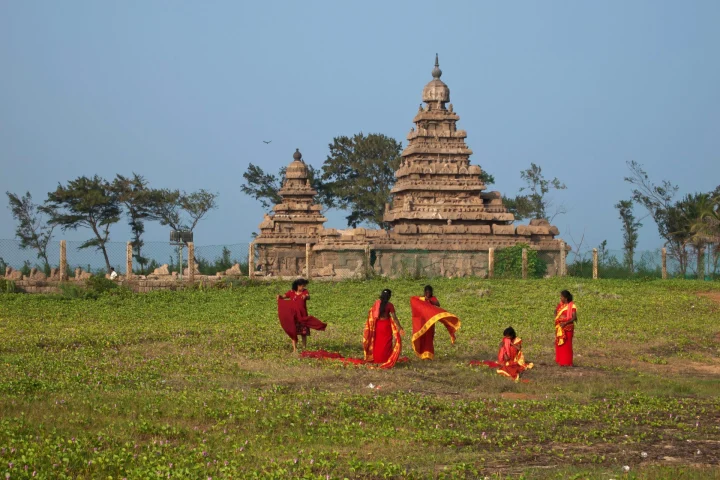
The Pancha Rathas, or Five Rathas, are a group of five small shrines at the southern end of Mahabalipuram. Each one was carved out of a single granite outcrop in the 7th century, under the Pallava kings. Rather than building up with blocks, the sculptors cut downwards and inwards into solid rock, shaping walls, pillars, roofs and doorways as if they were carving a sculpture the size of a building.
They are part of the Group of Monuments at Mahabalipuram, a UNESCO World Heritage Site since 1984, and are protected by the Archaeological Survey of India (ASI).
On this page
Why they are called rathas
Ratha means chariot, and the monuments are traditionally named after the five Pandava brothers of the Mahabharata and their wife Draupadi. The names are a later popular tradition: the shrines were never linked to the Pandavas by the people who made them, and they were never consecrated or used for worship.
Work is generally dated to the reigns of Mahendravarman I and his son Narasimhavarman I (Mamalla), after whom the town is named, and is thought to have stopped around 668 CE. Some historians date parts of the group later. Look closely and you can see unfinished areas of rough rock at the bases and tops.
The five rathas
- Draupadi Ratha: the smallest, shaped like a thatched village hut with a curved roof, dedicated to the goddess Durga, with a figure of her carved inside.
- Arjuna Ratha: a small square temple with a pyramidal roof, well decorated, associated with Shiva.
- Bhima Ratha: a long rectangular structure with a barrel-vaulted roof, left unfinished inside.
- Dharmaraja Ratha: the tallest, a three-tiered square vimana with fine carvings of deities, including Harihara and Ardhanarishvara. It is an early model for the later Dravidian temple tower.
- Nakula–Sahadeva Ratha: set apart from the row, with an apsidal (rounded) back, in the style of a gajaprishta or “elephant’s back” roof.
The animal sculptures
Three free-standing animals are carved from the same rock. A life-size elephant stands beside the Nakula–Sahadeva Ratha, and its rounded back echoes the shape of the shrine. A lion sits near the Draupadi and Arjuna rathas, and a Nandi bull rests behind the Arjuna Ratha. Children especially enjoy the elephant, which is one of the best-known sculptures in Mahabalipuram.
Tickets and timings
At the time of writing, the site is open from about 6 AM to 6 PM. The ASI ticket, about ₹40 for Indian visitors and ₹600 for foreign visitors with free entry under 15, covers both the Pancha Rathas and the Shore Temple on the same day. Fees change from time to time, so check before you go.
Best time to visit
The sandy compound has almost no shade, so come early in the morning, especially between March and September. November to February is the most comfortable season. Morning light shows the carving detail well.
Practical tips
- Distance: the Pancha Rathas and the Shore Temple are just over a kilometre apart, a few minutes by car.
- Guides: a guide helps you spot the iconography on the Dharmaraja Ratha, which is easy to miss.
- Stone carvers: the lanes nearby are lined with workshops making granite sculptures, a craft that continues the town’s Pallava tradition.
- Heat: carry water and a hat; the sand reflects the sun.
Visiting from Pondicherry
Mahabalipuram is about 96 km from Pondicherry, roughly two hours along the East Coast Road. A day trip comfortably covers the Pancha Rathas, the Shore Temple, Arjuna’s Penance and Krishna’s Butter Ball. Our Mahabalipuram and Kanchipuram heritage tour includes them by car with driver. More ideas on our heritage page.
Official information: UNESCO World Heritage Centre
Frequently asked questions
Why are the Pancha Rathas named after the Pandavas?
The names are a later popular tradition. The shrines are 7th-century Pallava monuments with no known link to the Mahabharata heroes, and they were never consecrated.
Are the Pancha Rathas carved from a single rock?
Each ratha is carved from its own single piece of granite outcrop, cut from the top downwards, along with the elephant, lion and Nandi sculptures.
Is the Shore Temple ticket valid for the Pancha Rathas?
Yes. At the time of writing, one ASI ticket covers both sites on the same day.
How much time do you need at the Pancha Rathas?
About 45 minutes to an hour is enough for most visitors.