Last updated:
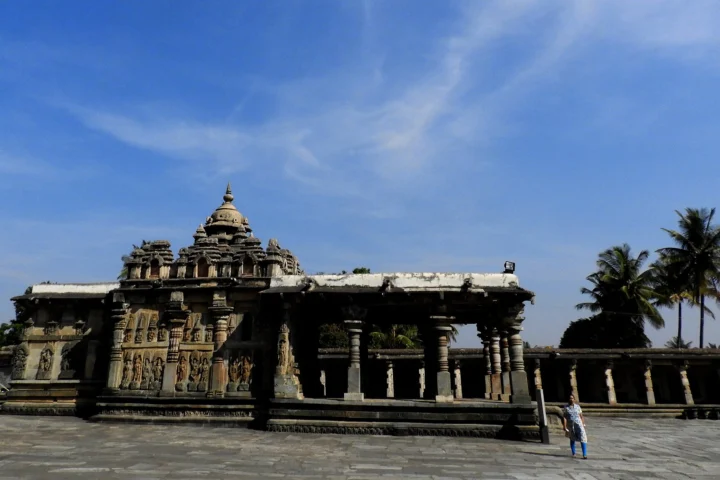
Halebidu, about 16 km from Belur in Karnataka’s Hassan district, was once Dorasamudra, the capital of the Hoysala kings. The name Halebidu means “old camp” or “old capital”, given after the city was sacked and abandoned in the 14th century. What survives is a group of temples of extraordinary richness, led by the Hoysaleswara Temple, whose outer walls are among the most densely carved in India.
Together with the Chennakeshava Temple at Belur and the Keshava Temple at Somanathapura, it was inscribed on the UNESCO World Heritage List in 2023 as the Sacred Ensembles of the Hoysalas. The temple is protected by the Archaeological Survey of India (ASI).
On this page
History
Construction began around 1121 CE during the reign of Vishnuvardhana and continued until about 1160. An inscription credits an officer named Ketamalla with building it. The temple stood on the bank of a large man-made lake at the heart of the Hoysala capital.
In the early 14th century the city was attacked and plundered by armies of the Delhi Sultanate, and the Hoysala capital never recovered. The towers that once rose above the two shrines have been lost, which is why the temple looks low and flat-roofed today, but the sculpted walls survived remarkably well.
What to see
- Twin shrines: the temple is a dvikuta, with two identical shrines side by side, dedicated to Shiva as Hoysaleswara and Shantaleswara, each with a lingam.
- Two Nandi pavilions: on the east side, each shrine has its own pavilion with a large seated Nandi facing it. There is also a small shrine to Surya.
- The friezes: walk slowly around the outside. The lower bands run in horizontal layers of elephants, lions, scrollwork, horsemen, scenes from the Ramayana, Mahabharata and Bhagavata Purana, mythical makaras and swans. Look for the battle scenes and the stories of Krishna.
- Large reliefs: above the friezes, about 340 large sculptures show gods, goddesses and episodes from Hindu mythology in remarkable detail.
- ASI museum: a site museum in the temple grounds displays sculptures and fragments recovered from the old capital.
- Nearby: within a few kilometres are the Jain basadi complex of Halebidu and the Kedareshwara Temple, both in the Hoysala style.
Timings and tickets
At the time of writing the temple grounds are open from early morning until evening and entry is free. The ASI museum is open from about 9 AM to 5 PM, is closed on Fridays and charges a small fee. ASI fees at World Heritage monuments are revised from time to time, so check the current rules before you go.
Tips for your visit
- Footwear and dress: leave footwear outside before entering the temple, and dress modestly.
- Hire a guide: the friezes are a picture book of Hindu mythology, and a good guide will point out stories you would otherwise walk past.
- Light: morning and late afternoon light shows the depth of the carving best; midday sun flattens it and heats the stone.
- Combine with Belur: see the Chennakeshava Temple at Belur in the morning and Halebidu after lunch.
Visiting from Pondicherry
Halebidu is about 30 km from Hassan and roughly 210 km from Bengaluru, so from Pondicherry it is part of a multi-day Karnataka tour rather than a quick trip. Our Hoysala temples and Mysore tour covers Belur and Halebidu together with Mysore, by car with driver; interstate permit charges apply for Karnataka. See also our temples, heritage and museums and art pages.
Frequently asked questions
Who built the Hoysaleswara Temple at Halebidu?
It was built from around 1121 CE under the Hoysala king Vishnuvardhana; an inscription credits an officer named Ketamalla. Work continued until about 1160.
Is there an entry fee for the Halebidu temple?
At the time of writing entry to the temple is free, while the ASI site museum charges a small fee. Check before you go, as ASI fees are revised.
Is the Halebidu museum open on Fridays?
No. At the time of writing the ASI museum at Halebidu is closed on Fridays.
Why does the Hoysaleswara Temple have no tower?
Its original towers over the two shrines have been lost, so today the temple appears flat-roofed.
Can Belur and Halebidu be visited in one day?
Yes. They are about 16 km apart, so both temples fit comfortably into one day.