Last updated:
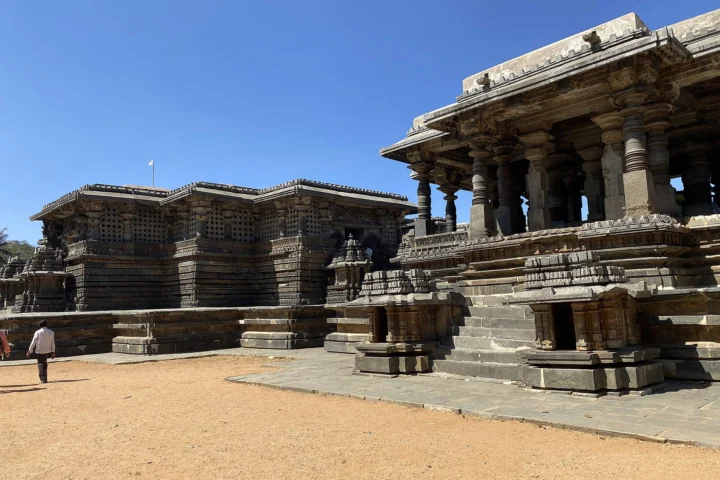
The Chennakeshava Temple in Belur is one of the high points of Indian temple art. Built of soft, fine-grained soapstone by the Hoysala kings, its walls, brackets and pillars are carved with a delicacy that looks closer to ivory or sandalwood than stone. Unlike many monuments of its age, it is still a working Vishnu temple, with daily worship, priests and pilgrims.
In 2023 the temple was inscribed as a UNESCO World Heritage Site together with the Hoysaleswara Temple at Halebidu and the Keshava Temple at Somanathapura, under the name Sacred Ensembles of the Hoysalas. Belur stands on the Yagachi river in Hassan district, Karnataka.
On this page
History
King Vishnuvardhana of the Hoysala dynasty commissioned the temple in 1117 CE, when Belur was an early Hoysala capital. Tradition holds that the work continued over three generations and took about 103 years to finish. The temple is dedicated to Chennakeshava, “the handsome Keshava”, a form of Vishnu. Belur also gained importance as a Vaishnava centre after Vishnuvardhana’s association with the philosopher Ramanujacharya.
In 1326 CE Belur and Halebidu were plundered by armies of the Delhi Sultanate. The temple was later repaired under the Vijayanagara Empire, notably during the reign of Harihara II, and the tall gopuram at the entrance was added during these Vijayanagara-era repairs.
What to see
- The main temple: a single-shrine temple on a raised platform, its outer walls covered with large reliefs of deities and scenes from the epics above bands of elephants, lions and scrollwork.
- Madanikas: the bracket figures of celestial dancers under the eaves, about 40 originally, of which 38 survive. Each has its own pose and expression: a dancer, a hunter, a woman dressing her hair, a dancing Saraswati. These are the most photographed sculptures in Belur.
- The hall of pillars: inside the dim mandapa are 48 ornate pillars, many of them lathe-turned and no two exactly alike. The Narasimha pillar and the Mohini pillar are the best known; carry a torch or ask the guide to light them up.
- Kappe Chennigaraya Temple: a smaller temple to the south, built at the same time by Queen Shantala Devi, Vishnuvardhana’s consort.
- Garuda and lamp pillars: the Garuda pillar facing the main temple dates from the Vijayanagara period, while the lamp pillar (Deepa stambha) is from the Hoysala period.
- The kalyani: a stepped water tank in the north-east corner of the complex.
Timings, entry and guides
At the time of writing the temple is open from about 7:30 AM to 5:30 PM, with the sanctum closed for short breaks during the day for rituals. Entry is free. Authorised guides wait near the entrance and charge a fee; a good guide is well worth it, because much of the iconography is easy to miss. Check before you go, as timings can change on festival days.
Tips for your visit
- Dress modestly: it is an active temple; cover shoulders and knees, and leave footwear at the stand outside.
- Go early: morning light is softer on the carvings and the courtyard is quieter before tour buses arrive.
- Respect the shrine: do not photograph the deity in the sanctum.
- Do both temples: Halebidu is only about 16 km away; see Belur in the morning and Halebidu after lunch.
Visiting from Pondicherry
Belur is a long way from Pondicherry, more than 500 km by road, so it is visited as part of a Karnataka tour. It lies about 217 km from Bengaluru and roughly 160 km from Mysore. Our Hoysala temples and Mysore tour combines Belur, the Hoysaleswara Temple at Halebidu and the Mysore Palace by car with driver; interstate permit charges apply for Karnataka. See also our temples and heritage pages.
Frequently asked questions
Who built the Chennakeshava Temple in Belur?
The Hoysala king Vishnuvardhana commissioned it in 1117 CE. Tradition says it took about 103 years and three generations to complete.
Is there an entry fee for Belur temple?
No, entry is free at the time of writing. Authorised guides charge separately.
Is Belur a UNESCO World Heritage Site?
Yes. Since 2023 the Chennakeshava Temple has been part of the UNESCO site Sacred Ensembles of the Hoysalas, with Halebidu and Somanathapura.
How far is Halebidu from Belur?
About 16 km, around half an hour by car, so both temples are easily seen in one day.
What is the dress code at Belur temple?
There is no strict official dress code at the time of writing, but it is a working temple, so modest clothing covering shoulders and knees is expected.